

Every marketing team has quietly dreamed about it. That one piece of content that breaks through the noise, floods notifications, and puts the brand name in front of millions overnight. Going viral feels like the ultimate marketing win, free reach, massive attention, cultural relevance delivered instantly.
Until it isn’t.
In 2026, going viral without a system behind your brand is not an opportunity. It is a liability. The same internet that can make a brand a household name in 48 hours can dismantle years of trust in less time than it takes your PR team to schedule an emergency call. And the terrifying part? Most brands discover they are in crisis not from internal monitoring, but from a Twitter thread they were tagged in at 11pm on a Friday.
This is not a guide about avoiding the internet. It is a guide about understanding what the internet actually does to brands that are not prepared for its full power, and how the smartest companies in 2026 are building the infrastructure to survive it.
The Internet Rewards Emotion, Not Accuracy
Before understanding why brands go viral for the wrong reasons, you need to understand what the internet actually rewards. It is not quality content, factual accuracy, or careful messaging.
It rewards emotion. Specifically, it rewards outrage.
Research from MIT found that false information spreads six times faster than accurate information on social platforms. The reason is psychologically straightforward: content that triggers strong emotional reactions, anger, disgust, disbelief, secondhand embarrassment, generates more immediate engagement than content that informs or educates. A thoughtfully written brand post explaining your company values generates polite appreciation. A poorly worded caption that lands wrong generates screenshots, quote tweets, and Reddit threads that run for days.
The algorithms governing what billions of people see every day are not neutral curators. They are engagement optimization engines. Every share, every angry comment, every “did you see this?” reaction signals to the platform that this content is generating attention, and attention is what platforms sell to advertisers. The algorithm does not distinguish between positive engagement and negative engagement. Both feed the machine.
For brands, this creates a deeply uncomfortable reality: the moment content starts generating emotional friction, the platform actively amplifies it to more people. The crisis does not slow down when it gains momentum. It accelerates.
“Good Content” Rarely Wins the Attention War
Here is something most content strategies do not account for: quality is not the primary driver of social media spread. Emotion is.
A technically perfect piece of branded content, well-designed, carefully written, strategically timed, can generate modest engagement and disappear into the algorithmic void within hours. Meanwhile, a blurry screenshot of an intern’s mistake gets reshared across five platforms before the office opens the next morning.
This is not an argument against creating quality content. It is an argument against believing that quality content alone is sufficient protection against viral backlash. The hidden mechanics of social media engagement are built around what behavioral scientists call engagement addiction, the neurological reward loop that keeps users scrolling by feeding them content that triggers emotional peaks.
Smart brands in 2026 are not just asking “is this content good?” They are asking “what emotional reaction does this content trigger, and are we prepared for that reaction at scale?” That second question is the one most content teams never ask, and its absence is where most viral disasters are born.
The Brands That Went Viral for All the Wrong Reasons
The most useful education in brand crisis management is not theoretical. It is historical. Three cases from the last decade define what modern viral disaster actually looks like, and what it genuinely costs.
Bud Light lost its position as America’s best-selling beer, a title held for over two decades, following a partnership that triggered organized, sustained consumer backlash. The brand’s response was widely criticized as slow, inconsistent, and caught between competing audience expectations with no clear narrative position. The financial damage exceeded one billion dollars in lost sales. The lesson was not about the partnership itself. It was about entering culturally charged territory without crisis architecture in place to manage the inevitable reaction.
Balenciaga released a campaign in 2022 that sparked immediate and intense public outrage. The backlash was swift, the screenshots were permanent, and the brand’s attempts at explanation were perceived as inadequate by a significant portion of its audience. For a brand built on aspirational exclusivity, the crisis hit at the most sensitive possible point: trust. What Balenciaga demonstrated was that shock marketing in 2026’s social environment carries existential risk, because the audience that amplifies your controversy is not your customer base. It is everyone else.
Domino’s faced a crisis more than a decade ago when two employees filmed themselves behaving unsanitarily with food and posted the video online. Within 24 hours it had been viewed millions of times. The case became foundational in crisis management education not because of the scale of the incident, but because of what it exposed: no real-time monitoring infrastructure, no escalation protocol, and no designated crisis response ownership. The brand eventually recovered, but the case permanently changed how the food industry thinks about social monitoring and the speed at which consumer trust collapses.
What these three disasters consistently teach is this: the incident is rarely the real problem. The system failure behind the incident is the problem, and that failure existed long before the crisis became public.
The Real Problem Is Not the Post, It Is the System Behind It
Every brand crisis that goes viral shares a common structural origin. It is not a rogue employee, an agency mistake, or bad luck. It is an operational gap between content creation and genuine accountability, and most brands have this gap running silently through their entire content pipeline.
Content pipelines fail under pressure because they are built for speed, not resilience. The modern marketing team is optimized for output, more posts, more channels, more formats, faster turnaround. The approval processes that exist are often performative: a Slack message asking “does this look okay?” before hitting publish is not a content review system. It is collective responsibility diffusion.
The “I thought someone checked it” culture is one of the most dangerous dynamics in modern marketing teams. It produces content that has technically been seen by multiple people but critically evaluated by none of them. Everyone assumed someone else was applying judgment. Nobody was.
When virality exposes this gap, and eventually it always does, the brand’s weakness is not just visible to its critics. It is visible to its customers, its investors, and its own team. The viral moment becomes a public audit of whether the brand actually operates with the discipline it claims to represent.
The 4 Silent Failures Behind Most Viral Backlashes
Understanding why brands end up in crisis requires identifying the four failure modes that appear consistently across virtually every viral disaster.
Content Review Failure is the most common. The question “who approved this?” after a crisis reveals that the approval chain was either missing, performative, or bypassed under deadline pressure. Effective content review in 2026 requires structured risk evaluation against current cultural context, not just a sign-off from someone already mentally onto the next task.
Context Blindness happens when content makes complete sense inside the organization but lands entirely differently in public. Internal teams develop tunnel vision around their own messaging. They understand the intent so clearly that they cannot see how the execution will land for an audience encountering it without that internal context. The post made sense in the marketing meeting. It did not make sense to two million people who had never heard the internal reasoning behind it.
Platform Mismatch is an increasingly costly mistake as brand presence expands across channels with genuinely different cultures and audience expectations. Content that performs authentically on TikTok, casual, self-aware, slightly irreverent, can destroy professional credibility when it migrates to LinkedIn. What reads as relatable humor in one environment reads as brand immaturity in another. Platform-native content strategy is not optional in 2026, it is brand risk management.
Monitoring Delays are how brands discover crises too late. The average brand without real-time sentiment monitoring discovers a developing social media crisis between four and seven hours after it begins spreading, by which point screenshots have circulated, mainstream accounts have amplified it, and the narrative has already been written by people who are not the brand. Four hours in a viral cycle is not a delay. It is a lifetime.
What Actually Happens When a Brand Loses Narrative Control
The moment a brand loses control of its own narrative, something predictable and damaging happens: the audience fills the vacuum with their own story, and that story is almost always worse than the truth.
Public perception shifts faster than any brand communications team can respond. The internal escalation process alone, discovering the issue, briefing leadership, drafting a response, getting legal approval, scheduling publication, can take six to twelve hours. In that window, the internet has already decided what happened, why it happened, who is responsible, and what the appropriate consequence should be.
Screenshots outlive apologies. The original offending post can be deleted within minutes. The screenshots of that post will circulate for years. They will resurface every time the brand does something newsworthy. They become permanent fixtures in the brand’s public biography, discoverable by any journalist, competitor, or skeptical consumer who takes thirty seconds to search.
The algorithm does not care about your intent. A brand can have the purest intentions behind a piece of content and still trigger a crisis response if the execution lands wrong. Intent is invisible on the internet. Execution is everything.
Why Most Brand Apologies Fail Instantly
When a brand crisis goes public, the pressure to respond quickly produces one of the most reliably ineffective responses in modern marketing: the corporate apology that satisfies no one.
The language of corporate PR, “we apologize to anyone who was offended,” “this does not reflect our values,” “we are committed to doing better”, has been encountered so many times by modern consumers that it triggers immediate cynicism. People have learned to read these statements as evidence of damage control rather than genuine accountability. The more polished the statement, the less human it reads. The less human it reads, the less credible it feels.
The difference between accountability and damage control is felt, not just read. Accountability requires specific acknowledgment of what went wrong, genuine ownership without qualification, and a concrete change, not a commitment to investigate whether a change might be appropriate. Damage control protects the brand’s legal and reputational position. Audiences in 2026 are sophisticated enough to distinguish between the two almost immediately.
Over-polished responses make things worse because they signal that the brand’s primary concern is managing perception rather than addressing actual harm. In a crisis, the brands that recover fastest are those that respond with visible human judgment rather than legal-approved corporate language, and that kind of response only happens when the groundwork has been laid long before the crisis arrives.
The First 24 Hours: What Smart Brands Actually Do
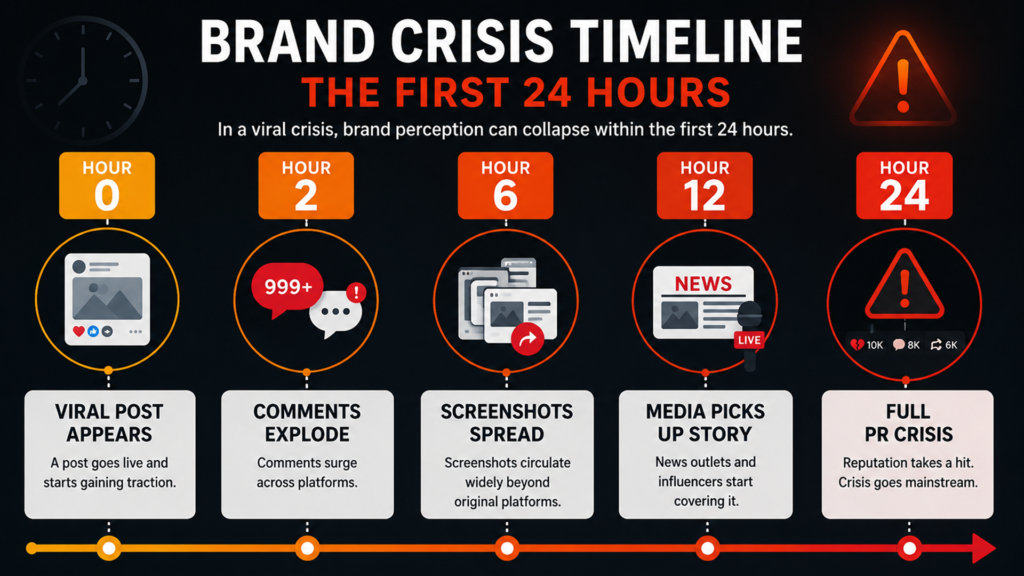
The first 24 hours of a brand crisis are not a communications challenge. They are an operational challenge. What happens in that window determines whether the crisis becomes a chapter in the brand’s history or the defining story of what the brand actually is.
Freeze outbound content immediately. Scheduled posts going out during an active crisis are one of the most common and most damaging mistakes brands make. An upbeat promotional tweet published three hours into a reputation crisis signals to audiences that the brand is either unaware or indifferent, both of which accelerate the backlash.
Turn on real-time sentiment tracking. Without live monitoring data, crisis response is based on assumptions. With it, response can be calibrated to what audiences are actually saying, which platforms the conversation is concentrated on, and whether sentiment is escalating or stabilizing.
Shift tone before audiences shift perception. The brand’s communication tone during a crisis should change before the public demands it. Proactive tone adjustment signals awareness and control. Reactive tone adjustment, changing only after public pressure intensifies, signals that the brand is following the audience rather than leading the response.
Align internal teams before posting again. Fragmented internal communication during a crisis produces fragmented external messaging. Before any public statement goes out, every person who might speak on behalf of the brand needs to be aligned on the same facts, the same narrative, and the same response boundaries.
You are not handling a crisis. You are being publicly evaluated in real time by every customer, competitor, journalist, and casual observer who encounters the story.
Virality Without Infrastructure Is a Liability

The brands most at risk from viral backlash are not the ones producing bad content. They are the ones producing large volumes of content without the governance infrastructure to catch errors before publication, and without the crisis architecture to respond effectively when something goes wrong.
Attention magnifies operational weakness. When a brand goes viral, everything about how it operates becomes visible at scale: how it responds to customers, how its teams communicate publicly, whether its values are performative or genuine. A brand with strong operational discipline looks stronger under scrutiny. A brand with governance gaps looks worse.
Fast growth without governance is public risk. The marketing teams moving fastest in 2026 are not the ones producing the most content. They are the ones producing content that is strategically sound, contextually aware, and backed by systems that can absorb a crisis without losing narrative control.
Modern branding now requires crisis architecture as a standard operating component, not an emergency plan pulled out once every three years, but a living system tested, updated, and integrated into daily content operations. This is precisely the kind of infrastructure that separates brands which grow confidently from brands that grow nervously, always one post away from a problem they are not ready to handle.
How Smart Brands Bulletproof Their Reputation
The brands that consistently emerge from potential crises without lasting damage share four operational practices that most of their competitors simply do not have in place.
A pre-post risk filter is a structured evaluation applied to content before publication. It asks specific questions: Does this content reference any culturally sensitive territory? Could this land differently on a platform other than the one it was created for? What is the worst-faith interpretation of this post, and are we prepared to respond to it?
Escalation systems built before emergencies are what separate brands that respond in hours from brands that respond in days. Knowing in advance who owns the crisis response, who has authority to pause campaigns, who drafts the public statement, and who approves it means that when something goes wrong the system activates immediately, rather than everyone waiting for someone else to take ownership.
Training teams for context, not just creativity means building marketing teams that understand cultural dynamics, platform psychology, and audience sensitivity, not just content production skills. The most dangerous person on a marketing team in 2026 is a highly creative individual with no contextual judgment and no escalation reflex.
Treating brand safety as a growth strategy reframes reputation management from a defensive cost to an offensive advantage. Brands with strong reputational brand positioning attract better partnerships, earn higher customer trust, retain talent more effectively, and recover faster from the inevitable friction points that every brand eventually encounters.
This is the approach Markmates was built around, the belief that brand protection is not a separate discipline from brand growth. It is the foundation that makes growth sustainable. The brands we work with do not treat crisis readiness as an afterthought. They treat it as the structural prerequisite for doing bold marketing without existential risk attached to every campaign.
Volatility Is Not the Same as Virality
One of the most dangerous ideas circulating in modern marketing is that controversy is a shortcut to attention, and that attention is a shortcut to brand growth. It is not. It is a shortcut to visibility, which is a fundamentally different thing.
Controversial attention rarely builds long-term trust because the audience it attracts is primarily interested in the controversy, not the brand. The followers gained during a viral controversy moment are among the lowest-quality brand relationships a company can acquire: highly engaged in the moment, likely to disengage or reverse their sentiment the moment the controversy cools.
Sustainable attention is built through consistent credibility, showing up reliably with content that is genuinely useful, genuinely entertaining, or genuinely reflective of values the audience shares. This compounds over time in a way that controversy cannot. The brands with the most durable audience relationships in 2026 are not the ones that broke the internet. They are the ones that consistently showed up for their audience without manufacturing drama to drive engagement.
Smart brands optimize for credibility, not chaos. Credibility compounds. Chaos is rented.
The New Rules of Going Viral in 2026
For brands that still want to achieve genuine viral reach, and there are absolutely legitimate ways to do it, the rules have evolved significantly.
Algorithms in 2026 reward emotional intensity, but the emotion does not have to be outrage. Genuine joy, surprising relatability, unexpected vulnerability, and authentic behind-the-scenes content all trigger the emotional engagement that drives shares, without the backlash risk of controversy.
Relatability outperforms perfection consistently across every platform. Highly produced brand content that feels corporate and distant generates lower engagement than imperfect content that feels human and honest. The brands winning the organic attention game are the ones willing to show the reality behind the brand, the genuine personality, the actual team, the real process.
Platform-native storytelling means creating content specifically for how each platform’s audience consumes media, not repurposing the same asset across every channel. TikTok requires a different narrative structure than LinkedIn. Instagram stories work differently than YouTube Shorts. Brands that understand these differences at a granular level consistently outperform those treating every platform as an interchangeable distribution.
Community matters more than reach in 2026. A brand with 50,000 deeply engaged followers who actively advocate for the brand has more commercial and reputational resilience than a brand with two million passive followers who feel no genuine connection. Community is what protects a brand when things go wrong, because a genuine community defends its brand rather than amplifying the criticism.
If You Still Want to Go Viral, Do It Intelligently
Going viral is not inherently dangerous. Going viral without understanding the environment you are releasing content into is.
Understand platform psychology, know not just where your audience is, but how they behave on each platform, what they share, what they mock, what they celebrate, and what triggers their protective instincts toward brands they love.
Use emotion without manipulation, create content that connects genuinely rather than engineering outrage or manufacturing controversy for its own sake. Audiences in 2026 are remarkably sophisticated at detecting when emotion is being weaponized for engagement, and their response to detecting it is rarely charitable.
Create conversation rather than controversy, design content that invites genuine audience participation, questions, perspectives, shared experiences, rather than positioning the brand in opposition to any group, idea, or cultural moment.
Build trust before amplification, earn your audience’s goodwill through consistent, valuable content before attempting the high-risk, high-reward content plays that carry real backlash potential. A brand with deep audience trust has a buffer when something lands wrong. A brand that has not built that trust has no margin for error.
Focus on resonance over randomness, the most sustainable viral content is not accidental. It is the product of deeply understanding what your specific audience cares about, what language they use, what problems keep them up at night, and what kind of content they feel proud to share with people they respect.
The Viral Brand Survival Kit: Your In Case Everything Explodes Checklist
When a crisis begins developing, execution speed determines outcomes. Keep this checklist accessible to every person on your team with publishing authority:
Pause all scheduled content automation immediately, nothing goes out until the situation is assessed and a response strategy is confirmed
Audit public sentiment across every active platform, identify where the conversation is concentrated, how fast it is moving, and what the primary narrative being constructed actually is
Assign clear response ownership, one person leads the crisis response. Multiple voices without coordination produce contradictory messaging that amplifies rather than contains the crisis
Monitor screenshots and reposts actively, the original post can be deleted. The screenshots cannot. Track where they are appearing and which accounts are amplifying them
Prepare executive communication, determine whether leadership needs to speak publicly, through which channel, and with what level of specificity before the decision is made under pressure
Track platform-specific reactions separately, the crisis may be severe on one platform and barely registering on another. Response strategy should be calibrated by platform, not applied uniformly
Document everything in real time, a timestamped record of what was known, when it was known, and what decisions were made is essential for both internal accountability and any external communication that follows
Frequently Asked Questions
What is the difference between going viral and a brand disaster?
Going viral means your content reaches a significantly larger audience than your existing following through algorithmic amplification and organic sharing. A brand disaster happens when that amplification is driven by negative emotion, outrage, disgust, or disbelief, rather than genuine audience enthusiasm. The content spreads just as fast, but the narrative being built around your brand is one you did not write and cannot easily undo. The difference is not the size of the moment. It is the sentiment driving it.
How do brands recover from a viral crisis in 2026?
Brand crisis recovery in 2026 requires four things done in sequence: immediate containment of the spread by pausing all outbound content, honest and specific public acknowledgment that does not read like legal damage control, a concrete visible change rather than a vague commitment, and consistent follow-through over weeks and months that proves the response was genuine. Brands that recover fastest are those with crisis architecture already in place before the incident, because they can respond in hours rather than days, before the narrative fully sets against them.
Why do most brand apologies make things worse?
Because they are written to protect the brand rather than to genuinely address the harm. Corporate PR language, vague, passive, carefully qualified, signals to modern audiences that the brand’s priority is reputation management, not accountability. In 2026, consumers are sophisticated enough to recognize the difference instantly. An apology that reads like it went through three rounds of legal review before publication will always perform worse than one that sounds like a human being who actually understood what went wrong and is genuinely sorry about it.
How can brands go viral without triggering a backlash?
The safest path to genuine viral reach is content built around authentic emotion rather than manufactured controversy. Unexpected vulnerability, behind-the-scenes honesty, surprising relatability, and content that makes your audience feel seen rather than sold to, these consistently generate the kind of shares that build brand equity rather than erode it. The other non-negotiable is having a pre-post risk filter in place that evaluates every high-ambition piece of content through the lens of platform psychology and worst-case audience interpretation before it ever goes live.
What is the most important thing a brand can do before a crisis hits?
Build the infrastructure before you need it. That means a documented escalation protocol with clear ownership, a real-time sentiment monitoring system that catches developing narratives early, pre-built response frameworks that can be adapted quickly without starting from zero under pressure, and a content governance layer that evaluates cultural context before publication rather than apologizing for missing it afterward. The brands that handle crises well in 2026 are not better at improvising. They are better at preparing.
Virality Doesn’t Build Brands, Control Does
Attention is rented. Trust is earned. These are not interchangeable currencies, and the brands that confuse them are the ones that end up with millions of views and a fractured relationship with the audience that actually drives their revenue.
The strongest brands in 2026 are not the loudest. They are the most consistent, showing up reliably, communicating honestly, and building the operational discipline to maintain their reputation even when the internet decides to pay attention.
Modern marketing is no longer just performance. It is reputation management operating at internet speed, in real time, in public, with no ability to retract what has already been seen. The brands that thrive in this environment are not the ones with the most creative content teams. They are the ones with the most intelligent systems, systems that create well, review rigorously, monitor continuously, and respond with genuine human judgment when the inevitable moment of friction arrives.
Virality without control is a gamble. Control without creativity is invisibility. The brands winning in 2026 have learned to hold both simultaneously, and that balance is the most valuable competitive advantage in modern marketing.
If building that balance is something your brand is ready to take seriously, Markmates exists for exactly that conversation.