

Introduction: Why Most B2B SaaS Companies Fail at Go-to-Market
Most B2B SaaS companies do not fail because the product is bad.
They fail because they take a good product to the wrong customers, with the wrong message, through the wrong channels, before they have validated a single core assumption about their market.
That is a go-to-market problem. And in 2026, with longer sales cycles, more sophisticated buyers, and tighter capital environments across the US, UK, and Canada, the cost of getting it wrong has never been higher.
According to Gartner, only 34 percent of SaaS product launches meet their initial revenue targets in the first year. The gap between great product and real revenue is almost always a GTM execution gap, not a product gap.
This guide covers the complete B2B SaaS GTM strategy framework for 2026: from defining your ideal customer profile and choosing the right sales motion to building demand generation systems, pricing for growth, and using AI to create compounding operational advantage. Whether you are pre-revenue or scaling toward Series B, the principles here apply at every stage.
What Is a B2B SaaS GTM Strategy?
A B2B SaaS go-to-market strategy is the operational plan that defines how your company will reach its target customers, communicate its value, convert interest into revenue, and retain customers long enough to generate positive unit economics.
It is not your marketing plan. It is not your sales process. It is the system that connects your product to your market, your messaging to your buyer, and your revenue motions to your growth objectives.
The core components of a complete SaaS GTM framework are:
Your Ideal Customer Profile defines exactly who you are selling to. Your value proposition and positioning defines why they should choose you over alternatives. Your sales motion defines how you will convert interest into revenue. Your demand generation strategy defines how you will create and capture that interest in the first place. Your pricing model defines the commercial structure that aligns your value delivery with your revenue capture. And your customer success motion defines how you retain and expand the revenue you have already earned.
Every element depends on every other. A brilliant positioning statement aimed at the wrong ICP produces nothing. A highly qualified ICP with weak messaging produces the same result.
The 2026 B2B SaaS Market Landscape
Understanding the environment your GTM strategy will operate in is the prerequisite for building one that actually works.
Buyer behavior has fundamentally shifted. The modern B2B buyer in 2026 completes between 57 and 70 percent of their purchase decision process before speaking to a sales representative, according to Forrester. They research independently, evaluate alternatives through peer reviews and community content, and arrive at sales conversations already holding significant conviction about what they want. Your GTM strategy must reach and influence buyers during this self-directed research phase, not just at the point of sales contact.
AI-powered buying decisions are emerging. Buyers are increasingly using AI tools to research software categories, compare solutions, and generate shortlists. This makes your brand’s presence in AI-generated answers, not just search rankings, a genuine pipeline variable. Generative Engine Optimization is no longer optional for SaaS companies serious about top-of-funnel visibility in 2026.
Product-led and sales-led motions are converging. The binary debate between PLG and SLG is resolving into hybrid models where product experience generates a qualified pipeline that sales converts for enterprise deals. The most competitive SaaS companies in 2026 are not choosing one model. They are building the infrastructure to run both simultaneously.
How to Define Your Ideal Customer Profile for B2B SaaS

The Ideal Customer Profile is the foundation of every other element of your GTM strategy. Get it wrong and everything built on top of it performs below potential. Get it right and every downstream investment compounds.
An ICP is not a buyer persona. A persona describes an individual. An ICP describes a company: the firmographic, technographic, and behavioral characteristics of the organizations most likely to buy your product, derive genuine value from it, renew their contract, and expand their spend over time.
The firmographic dimensions of a strong ICP include company size, industry vertical, geographic market, revenue range, and organizational structure. The technographic dimension includes the existing tools and platforms in the prospect’s stack that signal compatibility with your product, or the absence of tools that signals the problem you solve is unaddressed. The behavioral dimension includes the specific business pain patterns, growth stage signals, and trigger events that indicate a company is actively experiencing the problem your product solves.
ICP validation requires data, not intuition. The most reliable validation method is analyzing your existing customer base: which customers have the highest retention rates, the strongest expansion revenue, the shortest sales cycles, and the most enthusiastic advocacy? The characteristics those customers share define your actual ICP, regardless of what you assumed it was when you went to market.
B2B SaaS Positioning and Messaging That Converts
Positioning is the strategic decision about where your product sits in the minds of your target buyers relative to every alternative they might consider. Messaging is how you communicate that position across every touchpoint in your GTM motion.
The most common positioning failure in B2B SaaS is describing what the product does rather than the specific outcome it delivers for a specific type of customer in a specific situation. Feature descriptions attract no one. Outcome specificity attracts exactly the right buyers.
A strong value proposition for B2B SaaS answers three questions with precision: Who specifically is this for? What specific problem does it solve? Why is this solution meaningfully better than the alternatives they are already using or considering?
The jobs-to-be-done framework is the most reliable structure for developing messaging that resonates: rather than describing your product through its features, describe the job your buyer is trying to get done and position your product as the best way to get that job done in their specific context.
Messaging must be tested before it is scaled. A positioning statement that converts in a sales conversation is not automatically the same one that performs in paid advertising, or in a cold email, or on a landing page. Every channel has its own context and compression requirement. Validate messaging in low-cost, high-feedback environments before committing budget to scale.
B2B SaaS Sales Motion: Choosing the Right GTM Model

The sales motion is the mechanism through which your company converts market interest into revenue. Choosing the wrong one for your product and market is one of the most expensive GTM mistakes a SaaS company can make.
Product-Led Growth works when your product can demonstrate its core value to an individual user quickly, without requiring organizational buy-in or complex implementation. PLG requires a short time-to-value, a product experience compelling enough to drive organic advocacy, and a business model that allows users to access meaningful functionality before a purchase commitment. It is most effective for collaboration tools, developer tools, and productivity software where the end user and the economic buyer are closely aligned.
Sales-Led Growth is appropriate when your product requires implementation complexity, organizational change management, multi-stakeholder buy-in, or enterprise-level customization before value is realized. Enterprise security software, complex data infrastructure, and workflow automation platforms that touch multiple departments typically require SLG because the buying decision cannot be made by a single end user experimenting with a free trial.
Hybrid GTM models are becoming the default for scaling SaaS companies in 2026. PLG creates a self-serve pipeline of activated users that sales can convert to enterprise contracts. SLG creates the enterprise revenue that funds product investment that improves the PLG experience. The two motions feed each other when the infrastructure connecting them is built deliberately.
Community-Led Growth is the emerging third model: building an engaged community of practitioners around the problem your product solves, which generates organic advocacy, peer-to-peer referrals, and brand authority that reduces the cost of every other acquisition channel. The SaaS companies investing in CLG in 2026 are building a distribution moat that compounds with every member who joins.
Demand Generation vs Demand Capture for SaaS
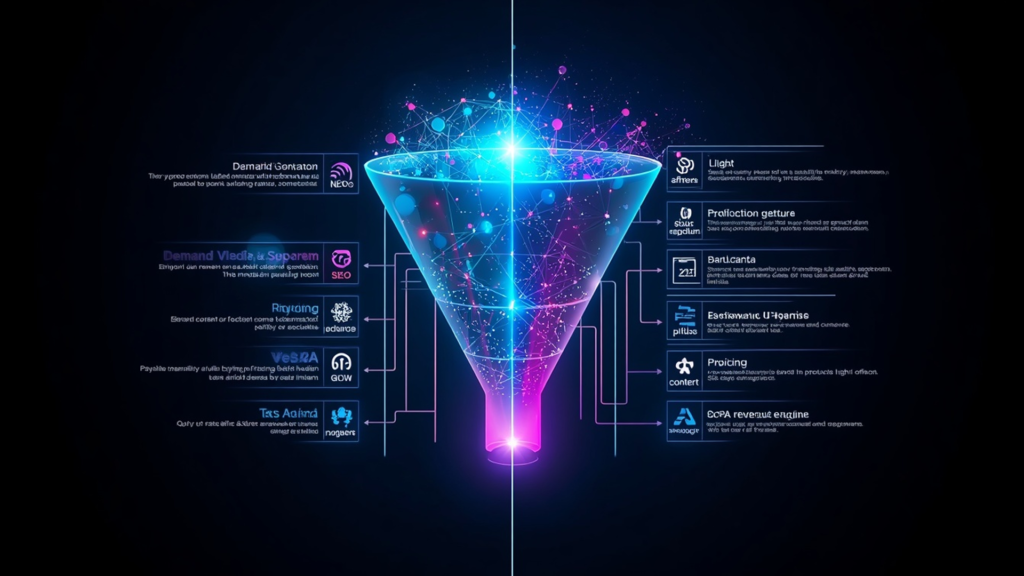
Most B2B SaaS GTM strategies over-index on demand capture and under-invest in demand generation. Understanding the difference is fundamental to building a pipeline that does not depend entirely on buyers who are already looking for your solution.
Demand capture reaches buyers who have already identified their problem, are actively researching solutions, and are comparing alternatives. Paid search, review site presence on G2 and Capterra, and bottom-of-funnel SEO content are all demand capture channels. They are high-converting because the buyer is already in the market, but they are inherently limited by the size of the existing demand pool.
Demand generation creates awareness and intent among buyers who have the problem your product solves but have not yet started actively searching for a solution. Thought leadership content, LinkedIn organic strategy, podcast presence, community engagement, and dark social channels are all demand generation investments. They take longer to produce pipeline but expand the total addressable market you are reaching and build brand preference before the buyer even enters a sales process.
The content strategy that drives the highest GTM ROI for B2B SaaS in 2026 combines topical authority building through long-form SEO content with bottom-of-funnel assets that convert buyers at the moment of decision. The pillar-cluster model, in which a comprehensive guide anchors a cluster of supporting articles targeting related keywords, is the most effective structure for building the domain authority that makes both organic rankings and AI citation eligibility compound over time.
Account-Based Marketing for B2B SaaS in 2026
Account-Based Marketing is the GTM approach that concentrates resources on a defined list of high-value target accounts rather than distributing them across broad inbound and outbound motions. For B2B SaaS companies selling into enterprise or mid-market accounts with long sales cycles and complex buying committees, ABM consistently produces higher pipeline quality and shorter sales cycles than volume-based demand generation.
The three ABM models each suit different stages and resources. One-to-one ABM dedicates customized campaigns to individual named accounts and is appropriate for the ten to twenty highest-value prospects in your market. One-to-few ABM groups accounts with shared characteristics into segments of 50 to 100 and builds campaigns tailored to the shared context of each segment. One-to-many ABM applies account-based targeting logic to larger lists and is closest to traditional demand generation with more sophisticated targeting.
AI-powered ABM in 2026 enables intent signal monitoring, contact enrichment, personalized content generation, and multi-channel sequence orchestration at a scale and speed that manual ABM operations cannot match. The combination of intent data from platforms like Bombora and 6sense with AI-driven personalization is producing measurable improvements in response rates and pipeline velocity for the SaaS teams deploying it systematically.
B2B SaaS Pricing Strategy That Drives Growth
SaaS pricing is a GTM lever that most founders underestimate. It directly influences who buys, how much they pay, how long they stay, and how much they expand their spend over time. Getting it wrong at the ICP validation stage means every subsequent GTM investment operates on a broken commercial foundation.
Value-based pricing anchors price to the measurable business outcome your product delivers rather than to your cost of delivery or competitor pricing. It is the most defensible pricing model for SaaS companies with strong positioning because it aligns the commercial relationship with genuine value exchange.
Usage-based pricing is gaining ground in 2026 as buyers increasingly resist seat-based models that charge for users regardless of actual product utilization. Usage-based models lower the barrier to initial adoption, create natural expansion paths as customer usage grows, and align the vendor’s revenue directly to customer success.
Packaging tiers that create clear upgrade paths are one of the highest-leverage pricing tactics available to SaaS companies. Good tier design creates a natural progression from the entry-level plan that captures initial buyers to mid-tier plans that capture expanding teams to enterprise plans that capture organizational buyers with complex requirements. Each tier should create a clear incremental value reason to upgrade, not just a higher price for the same features.
AI-Powered GTM Strategy for B2B SaaS in 2026

AI is transforming every layer of B2B SaaS GTM, from ICP research and intent signal monitoring to content production, campaign optimization, and sales process automation.
The most impactful AI GTM applications in 2026 are not the most visible ones. They are the operational infrastructure decisions: unified data layers that connect marketing, sales, and customer success signals into a single intelligence source; AI agents that handle the administrative workflows that consume sales rep time without generating revenue; and predictive models that surface the accounts most likely to convert before a human sales team would identify them manually.
Agentic GTM workflows are replacing the manual execution layer that once required dedicated headcount. Lead research, outreach personalization, CRM updating, meeting scheduling, pipeline reporting, and follow-up sequencing are all being handled by AI agents in the most efficient SaaS GTM operations in 2026. The sales team that remains focuses entirely on the conversations, relationships, and judgment calls that AI cannot yet replicate.
This is precisely the territory Markmates operates in with the SaaS founders and growth teams building the most capital-efficient GTM systems. The combination of strategic GTM architecture and AI-powered execution infrastructure is what separates the companies compounding their growth advantage from those still running 2022 playbooks in 2026.
B2B SaaS GTM Metrics and KPIs That Actually Matter
The metrics that define GTM health in B2B SaaS are not the ones that look best in a board presentation. They are the ones that reveal whether your growth engine is building toward sustainability or burning toward a wall.
Customer Acquisition Cost measures the total cost of acquiring a new customer including all sales and marketing spend. Customer Lifetime Value measures the total revenue a customer generates over their relationship with your company. The CAC-to-LTV ratio is the single most important unit economics metric for SaaS GTM: a ratio above 3:1 indicates a commercially sustainable acquisition motion; below 3:1 indicates that you are acquiring customers at a pace that is structurally difficult to sustain.
Net Revenue Retention measures what percentage of last year’s revenue from existing customers you are retaining and expanding this year. An NRR above 100 percent means your existing customer base is growing without adding a single new customer. For B2B SaaS, NRR above 110 percent is considered strong; above 120 percent indicates a customer success motion that is itself a growth engine.
Pipeline velocity measures how fast qualified opportunities move through your sales process to closed-won. Improving pipeline velocity requires understanding which stage in the process produces the most friction, which is itself a diagnostic that reveals the weak points in your GTM execution.
Time to First Value measures how quickly a new customer reaches the moment where they experience the core benefit of your product. TTFV is the most predictive metric for retention: customers who reach value quickly stay longer, expand faster, and advocate more actively than those who experience a slow or difficult onboarding.
Common B2B SaaS GTM Mistakes and How to Avoid Them
The mistakes that most commonly derail B2B SaaS GTM execution are not strategic failures. They are sequencing failures: doing the right things in the wrong order.
Going to market before validating product-market fit is the most expensive mistake and the most common. A GTM machine applied to a product that has not yet achieved genuine PMF does not accelerate growth. It accelerates the discovery of the same fundamental mismatch at much higher cost.
Targeting too broad an ICP too early produces diluted messaging, unfocused sales effort, and pipeline that converts slowly because every prospect requires different positioning. The discipline of serving one specific ICP exceptionally well before expanding is what creates the reference customers, the case studies, and the category credibility that make expansion into adjacent segments viable.
Choosing the wrong sales motion for your product stage and market is especially damaging because the cost of the mismatch compounds over time. A PLG motion applied to a product that requires enterprise implementation produces a frustrating free trial experience and no enterprise revenue. An SLG motion applied to a product where individual users can self-serve creates expensive acquisition costs for deals that should be closed without sales involvement.
Scaling before unit economics are proven is the GTM equivalent of stepping on the accelerator before confirming the car is pointed in the right direction. Every dollar of growth capital applied to a GTM motion with broken unit economics produces a bigger version of the same problem, not a path to profitability.
Frequently Asked Questions
What is a GTM strategy for B2B SaaS?
A B2B SaaS go-to-market strategy is the operational plan that defines how a software company reaches its target customers, communicates its value, converts interest into revenue, and retains customers long enough to generate sustainable unit economics. It includes ICP definition, positioning, sales motion selection, demand generation, pricing, and customer success, all working as a connected system rather than independent functions.
How is B2B SaaS GTM different from enterprise GTM?
B2B SaaS GTM typically involves shorter sales cycles, subscription-based revenue models, digital-first distribution, and product experience as a primary GTM lever through PLG. Enterprise GTM involves longer buying cycles, multiple stakeholders, higher contract values, more complex implementation requirements, and a heavier reliance on relationship-driven sales. Many scaling SaaS companies run both motions simultaneously as they expand upmarket.
What is the best GTM motion for early-stage SaaS?
For most early-stage SaaS companies, the best starting GTM motion is a highly manual, founder-led sales process focused on a tightly defined ICP. This produces the fastest feedback loops for validating positioning, identifying objections, and refining the product based on real buyer conversations. PLG and ABM motions require infrastructure and volume to function effectively and are better introduced once the manual sales motion has produced repeatable results.
How long does it take to build a repeatable GTM motion for SaaS?
For most B2B SaaS companies, building a genuinely repeatable GTM motion takes between 12 and 24 months from the first sales hire. The benchmarks that indicate repeatability are a consistent close rate on qualified opportunities, a sales cycle length that is predictable within a defined range, and a CAC-to-LTV ratio that holds stable as you increase the volume of new customer acquisition.
What GTM metrics should a SaaS founder track?
The metrics that matter most for SaaS GTM health are CAC, LTV, CAC-to-LTV ratio, Net Revenue Retention, pipeline velocity, Time to First Value, activation rate, and marketing-attributed pipeline as a percentage of total pipeline. These metrics together reveal whether your GTM engine is building toward compounding growth or running toward a unit economics wall.
How does AI change B2B SaaS GTM strategy in 2026?
AI changes SaaS GTM at three levels. At the intelligence layer, AI surfaces intent signals, account insights, and predictive conversion probability that improve targeting precision. At the execution layer, AI agents automate the administrative workflows that consume sales and marketing time without generating revenue. At the distribution layer, AI-powered search and answer engines create new top-of-funnel visibility channels that require GEO and AEO optimization alongside traditional SEO.
What is the difference between PLG and SLG for SaaS?
Product-Led Growth uses the product itself as the primary acquisition channel: free trials, freemium tiers, and viral in-product mechanics drive users to the product who then convert to paid plans. Sales-Led Growth uses a human sales team as the primary conversion mechanism, with marketing generating leads that sales converts through direct outreach and relationship management. PLG suits products where individual users can experience value quickly. SLG suits products requiring organizational buy-in and complex implementation.
Conclusion: Building a B2B SaaS GTM Engine That Compounds
The difference between a B2B SaaS company that grows predictably and one that grows erratically almost always comes down to whether it has a genuine GTM system or a collection of disconnected tactics that happen to be generating some revenue.
A B2B SaaS GTM strategy that treats every element as connected: the ICP informs the positioning, which informs the sales motion, which informs the demand generation approach, which informs the content strategy, which builds the brand authority that makes every other GTM investment more efficient over time.
The companies winning in SaaS in 2026 are not the ones with the biggest budgets. They are the ones with the most disciplined GTM systems: tightly defined ICPs, validated positioning, sales motions matched to their market, AI-powered execution infrastructure, and customer success engines that turn retention into expansion revenue.
If your B2B SaaS company is ready to move from tactical marketing to a strategic GTM system built for compounding growth, that is exactly the work Markmates does with the founders and revenue teams serious about building something that lasts.