
Introduction: Launch Day Is Already Too Late
Most B2B product launches are lost before they begin.
Not on launch day. Not in the first week of campaigns. They are lost in the months before go-live when the team is heads-down on a product and nobody is building the market that product will launch into.
The numbers make this brutally clear. According to research across more than 200 B2B product launches, up to 75 percent fail to meet their first-year revenue targets. Not because the product was bad. Because marketing was treated as something you do after the product is ready rather than a parallel workstream that begins six to nine months before anyone outside the company sees it.
And the window is shrinking. According to 6Sense’s 2025 research, 95 percent of the time the winning vendor is already on the buyer’s shortlist before a formal evaluation even begins. By the time your target buyer is actively researching solutions, they have often already decided whose content they trust, whose brand they recognise, and which vendor feels familiar enough to deserve a conversation.
If you are not building that familiarity before launch, you are launching cold into a market that has already formed its preferences without you.
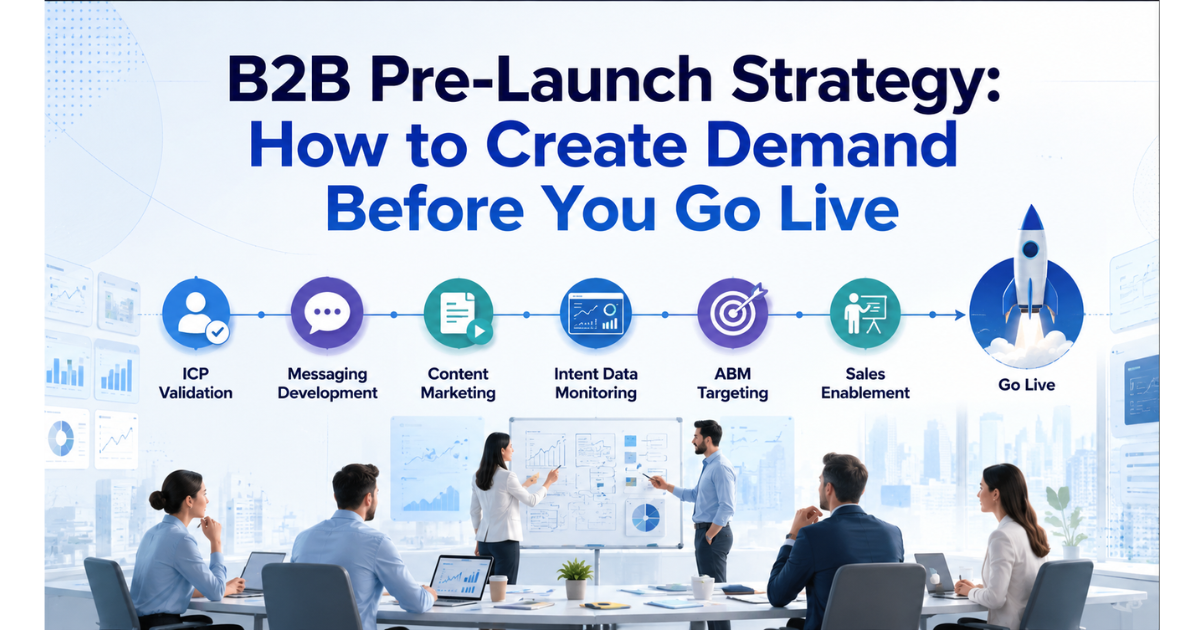
This guide walks through the complete B2B pre-launch strategy framework: from ICP validation and messaging development to intent signal monitoring, content engine building, sales enablement, and the timeline that gives every element room to compound before go-live. These are the pre-launch foundations the team at Mark Mates builds with B2B founders who understand that demand is not something you generate after a launch. It is something you engineer before it.
What Is a B2B Pre-Launch Strategy?
A B2B pre-launch strategy is the complete operational plan for building market awareness, demand, and qualified pipeline before a product officially goes live.
It is one of three distinct phases in a total launch strategy alongside the launch itself and post-launch. And it is consistently the most underinvested phase in B2B despite being the one that most directly determines whether launch day generates revenue or generates silence.
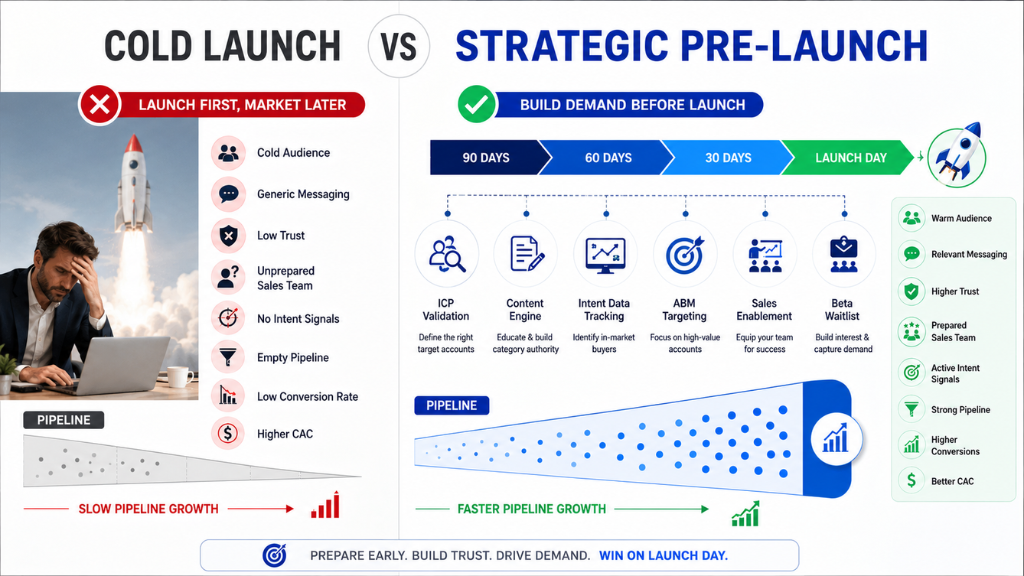
The pre-launch phase covers six interconnected areas: ICP validation to confirm you are targeting the right accounts, messaging development to ensure your value proposition resonates before you scale it, demand generation to warm your target market before they need to make a decision, intent signal monitoring to identify accounts already entering a buying cycle, sales enablement to make sure your team can confidently pitch the product from day one, and a soft launch to validate the entire motion before full go-live.
Done well, a B2B pre-launch strategy means that on launch day, you are not introducing your product to a cold market. You are going to live with a market that has been warming for months, a sales team that is fully enabled, and a pipeline of accounts that already know who you are.
Why B2B Pre-Launch Strategy Differs From Consumer Launches
Consumer products can generate viral awareness quickly through social sharing, influencer campaigns, and emotional storytelling that spreads fast. B2B is a fundamentally different environment.
B2B buying committees average between six and ten stakeholders in enterprise decisions. Sales cycles run between 30 and 18 months depending on contract size and complexity. Buyers complete between 57 and 70 percent of their purchase decision before engaging with any sales representative, according to Forrester’s B2B Buying Study.
The implication for pre-launch strategy is significant. By the time a B2B buyer engages with your sales team, their vendor shortlist is usually already set. The brands on that shortlist are the ones that showed up consistently during the research phase with content, perspectives, and expertise that built trust before any sales conversation took place.
For most technical B2B products, a minimum 90-day pre-launch planning cycle is required. For complex enterprise products or categories where significant market education is required, six months is a more realistic timeline for building the brand presence and demand signals that make launch day convert at the rates a proper pre-launch investment justifies.
Step 1: Build Your Cross-Functional Pre-Launch Team
The most successful B2B launches are not marketing events. They are whole-organization efforts assembled before product development is complete rather than after.
The optimal pre-launch team includes at least one representative from marketing, sales, product, customer success, legal, and leadership. Each function sees a different risk surface and a different opportunity in the launch. Without all of them in the room from the beginning, the launch plan will have gaps that only become visible under the pressure of go-live.
Marketing needs to know what the product does to build accurate positioning. Sales needs early exposure to the product to develop confidence in pitching it. Customer success needs to understand the onboarding journey before the first customer arrives. Legal needs to review messaging claims and any regulatory implications. Leadership needs to align on what success actually looks like in the first 90 days post-launch.
Assemble this team early. The pre-launch phase is where the foundational decisions that determine launch outcomes are made. Making those decisions with incomplete organizational input produces launch plans that look coherent on paper and break down in execution.
Step 2: Validate Your ICP Before Spending a Single Marketing Dollar
The most expensive mistake in B2B pre-launch is targeting the wrong audience at scale. And it is far more common than most teams acknowledge.
A sharp Ideal Customer Profile is the foundation of any pre-launch demand generation strategy that actually works. Not a broad market definition. Not a demographic persona template. A real, validated understanding of the specific accounts that get the most value from your product, have the highest propensity to buy, and are easiest to convert and retain.
The most reliable ICP validation method is a simple 80/20 analysis of your closest analogues: who are the customers in adjacent categories that share the characteristics of the buyer your product is built for? Which accounts have the smoothest sales cycles, the highest retention, and the strongest expansion revenue in comparable solutions? Those accounts define your prototype ICP.
Then validate it through direct customer development conversations before any marketing investment is made. Fifteen to twenty structured interviews with ICP-matched prospects will surface the specific pain language, trigger events, and buying criteria that your messaging must address. This investment takes two to three weeks. The alternative is discovering the same information six months post-launch after spending significant budget targeting the wrong accounts with the wrong message.
Step 3: Develop and Test Your Messaging Before You Scale It
Only 52 percent of B2B organizations have a clearly defined value proposition at launch. The other 48 percent go to market with messaging that was developed internally, reviewed internally, and never tested against the actual language and priorities of their target buyers.
Pre-launch messaging development starts with the specific job your target buyer is trying to get done. Not the features your product offers. Not the category it competes in. The specific outcome the buyer is trying to achieve and the specific friction they are currently experiencing in trying to achieve it.
The positioning statement that emerges from ICP validation interviews should describe the buyer’s pain in their own language, position your product as the most direct path to the outcome they are seeking, and articulate the specific, provable reason why your solution achieves that outcome better than the alternatives they are currently using.
Test this positioning in real conversations before committing budget to campaigns. Run it through five to ten sales conversations with ICP-matched prospects and measure the response: do they lean forward or do they look confused? Do they say “that is exactly what we are dealing with” or do they say “interesting, tell me more”? The first response confirms the messaging. The second reveals that the positioning is not specific enough yet.
Never scale a message you have not validated at a small scale. Misaligned sales and marketing messaging at launch creates a pipeline of leads your sales team cannot close because the expectation set by marketing does not match the reality the sales conversation reveals.
Step 4: Build Demand Before You Launch, Not After
The fundamental insight behind effective B2B pre-launch demand generation is that 95 percent of your target market is not in an active buying cycle right now. But all of them are forming impressions about which brands understand their world, which vendors they trust, and whose content actually helps them do their jobs better.
The brands that win in B2B are the ones present during that long formation period, not just the ones that show up loudly on launch day. Helpful content does not create immediate demand. It shapes future demand by building the trust and familiarity that makes your brand the instinctive choice when a trigger event finally activates a buying cycle.
Pre-launch content strategy for B2B should focus on three things: problem framing that educates your target market on the problem your product solves without selling the product, thought leadership that establishes your team’s expertise in the category before the product exists, and community engagement that builds your brand presence in the spaces your target buyers already inhabit.
LinkedIn organic content and LinkedIn paid distribution are the highest-return pre-launch awareness channels for most B2B audiences. A consistent publishing cadence of two to three pieces per week focused on the problem domain, combined with a modest paid amplification layer targeting your ICP accounts by firmographic and role criteria, builds category familiarity with the specific audience you will be selling to at launch.
Dark social channels including Slack communities, industry forums, and private LinkedIn groups are where B2B buyers share vendor recommendations and category opinions before they ever visit a website. Pre-launch presence in these communities, earned through genuine contribution rather than promotion, builds the peer-to-peer trust signals that influence shortlisting decisions before any formal evaluation begins.
A beta waitlist or early access program serves double duty in pre-launch. It captures first-party intent data from your highest-quality prospects, and it creates social proof that demand exists before the product is publicly available. A waitlist of 200 qualified prospects who requested early access is a more powerful launch signal than any paid campaign metric.
Step 5: Use Intent Data to Find In-Market Buyers Before Launch
Buyer intent data is behavioral information that signals when a company is actively researching, evaluating, or preparing to purchase a solution in your category. In B2B pre-launch, it is the most direct way to identify which accounts are in an active buying cycle right now, before your product is publicly available.
Intent data works best layered on top of solid ICP targeting rather than as a standalone prospecting tool. A list of in-market accounts that do not fit your ICP is wasted outreach. A list of perfect-fit ICP accounts with no current buying intent is a six-month nurture cycle. The combination of ICP fit and active intent signals is where pre-launch outreach produces the highest conversion rates.
The three intent signal categories most valuable for B2B pre-launch are first-party signals from your own digital properties including your pre-launch waitlist, content downloads, and webinar registrations; third-party intent signals from platforms like Bombora that track content consumption across a network of business websites; and review site signals from G2 and Capterra where accounts researching your category are leaving digital footprints before they ever contact any vendor.
Companies using intent data see between 1.5 and 2 times higher close rates compared to those using firmographic data alone, according to Demandbase research. For pre-launch specifically, the value is in timing: identifying the accounts already entering a buying cycle in your category and reaching them with your brand before your competitors do.
Step 6: Enable Your Sales Team Before External Launch
Research consistently identifies the internal sales team as the most common bottleneck in B2B product launches. Sales reps who do not feel confident pitching a new product will default to selling the old one, regardless of what the launch campaign is doing externally.
Pre-launch sales enablement requires four things: product knowledge that gives reps genuine confidence in what the product does and how it delivers value, a talk track that translates product features into buyer outcomes in language that resonates with ICP-matched prospects, an objection guide that prepares reps for the specific pushback they will encounter based on pre-launch customer development conversations, and a demo walkthrough that shows the product in the context of the buyer’s specific use case rather than a generic product tour.
All four of these materials should be created and trained months before the external launch, not the week before go-live. The reps who perform best in the first 90 days post-launch are those who have been living with the messaging and the demo long enough to deliver it naturally rather than reading from a script.
Step 7: Run a Soft Launch Before Full Go-Live
A soft launch is a controlled, limited release of your product to a defined group of target accounts before the full public launch. It is the most underused pre-launch tool in B2B and one of the most valuable.
The soft launch serves three functions: it validates that the sales motion works in real buyer conversations, it surfaces the objections and use case questions that the sales enablement materials need to address, and it generates the initial customer results and testimonials that the full launch campaign will use as social proof.
OpenAI’s approach to ChatGPT is the most widely studied example of this model in practice. By making the product freely available before monetizing it, the team built the trust, usage patterns, and social proof that made the transition to paid plans a conversion of an already-engaged user base rather than a cold market acquisition challenge.
For B2B, the soft launch equivalent is an early access program targeting twenty to fifty ICP-matched accounts selected from your pre-launch intent signal data. These accounts get first access in exchange for structured feedback, case study participation, and reference availability for the full launch.
Step 8: Set Pre-Launch KPIs That Connect to Revenue
Pre-launch metrics that do not connect to revenue are vanity metrics that feel like progress and produce no useful signal. The right pre-launch KPIs are the ones that tell you whether your demand generation is building genuine pipelines or simply generating impressions that will not convert.
The three core pre-launch metrics for B2B are: Marketing Qualified Lead quality measured by ICP match percentage not MQL volume, pipeline velocity in the soft launch window measured by how quickly target accounts move from first contact to scheduled conversation, and sales cycle length in early access deals measured against your ICP benchmark.
Supporting metrics include waitlist conversion rate from ICP-matched accounts, content engagement depth from target account domains, intent signal volume from your category on third-party platforms, and LinkedIn engagement rate from ICP-matched job titles and company sizes.
Build your pre-launch dashboard before you start generating data, not after. Defining what good looks like before you have results is what keeps the team focused on the metrics that matter rather than defaulting to the metrics that are easiest to report.
Account-Based Marketing as a Pre-Launch Demand Tool
For B2B products launching into niche markets or targeting a defined set of high-value accounts, Account-Based Marketing is the most precise pre-launch demand tool available.
ABM concentrates marketing resources on a curated list of target accounts selected based on ICP fit and intent signals rather than distributing them broadly across the total addressable market. For pre-launch, this means reaching the specific decision-makers at the specific companies most likely to buy your product and building familiarity with those accounts through multiple touchpoints before any sales outreach begins.
A pre-launch ABM motion typically covers three account tiers: Tier 1 consisting of ten to twenty highest-value accounts that receive fully personalized one-to-one content and direct executive outreach, Tier 2 consisting of fifty to one hundred accounts segmented by shared characteristics that receive customized content relevant to their specific industry or use case, and Tier 3 consisting of two hundred to five hundred accounts that receive targeted paid distribution of your pre-launch content across LinkedIn and display channels.
The combination of ABM targeting precision with intent signal data produces the highest pre-launch pipeline quality of any demand generation approach because it concentrates resources on accounts that both fit the ICP and are already showing active interest in the category you are entering.
Pre-Launch Timeline: 90, 60, and 30 Days Before Go-Live
The timing of pre-launch activities determines whether each element has enough runway to compound before launch day. The 90-day framework below assumes a product that is development-complete and entering final testing at the 90-day mark.
90 days out: Assemble the cross-functional launch team. Complete ICP validation interviews. Develop and test the positioning statement. Build the pre-launch waitlist landing page. Begin LinkedIn organic content publishing on problem-domain topics. Configure first-party intent signal tracking on all digital properties.
60 days out: Launch the beta waitlist and early access program. Activate LinkedIn paid distribution targeting ICP accounts. Begin third-party intent data monitoring through Bombora or 6sense. Complete sales enablement materials including talk track, objection guide, and demo walkthrough. Deliver sales team product training. Begin one-to-one ABM outreach to Tier 1 target accounts.
30 days out: Begin soft launch with early access accounts. Collect structured feedback and begin case study development. Review pre-launch pipeline metrics and adjust messaging where conversion signals are weak. Finalize launch campaign assets based on validated messaging. Brief customer success team on onboarding process and first-90-days support protocol.
Launch week: Full campaign activation across all channels. SDR outreach to intent-flagged accounts from pre-launch monitoring. PR and content amplification of launch announcement. Executive communication to Tier 1 ABM accounts. Pipeline review daily in the first two weeks.
Common B2B Pre-Launch Mistakes to Avoid
The mistakes that most consistently damage B2B launch outcomes are not strategic failures. They are sequencing failures: the right activities done in the wrong order or started too late to compound.
Skipping ICP validation and targeting a broad market at launch produces high CAC, low conversion rates, and a pipeline that is expensive to work but rarely closes. The ICP validation investment takes three weeks and prevents six months of misdirected spend.
Treating pre-launch as a marketing-only workstream creates the launch team misalignment that produces inconsistent messaging, an unprepared sales team, and a customer success function that is not ready for the onboarding volume launch day generates.
Starting content too late is the most common timeline mistake. Content needs six to twelve weeks to build topical authority signals and organic reach. Content published the week before launch generates no pre-launch demand. It generates noise.
Scaling paid demand generation before organic and intent signals are validated means spending significant budget confirming that the messaging does not resonate rather than amplifying messaging that does.
How AI Is Changing B2B Pre-Launch Strategy in 2026
According to Forrester, 94 percent of B2B buyers use generative AI during their buying process in 2026. Pre-launch content that is not structured to be cited by AI answer engines is invisible to a significant and growing portion of the buyer research phase.
GEO optimization for B2B pre-launch means publishing content that AI tools like ChatGPT, Perplexity, and Google AI Overviews can extract, cite, and recommend when buyers research the problem your product solves. This requires specific, authoritative, well-structured content that directly answers the questions your target buyers are asking during their research phase.
AI tools for pre-launch research are compressing the ICP validation timeline. AI-powered market analysis tools can surface competitor positioning, buyer pain language, and category trends in days rather than the weeks that manual research required. Intent signal platforms are using AI to predict which accounts are entering buying cycles before the signal volume reaches the threshold that earlier systems required for detection.
AI agents are beginning to replace the manual coordination work in pre-launch operations: monitoring intent signals, updating target account lists, personalizing outreach sequences, and reporting on pre-launch pipeline metrics without requiring dedicated headcount for each function.
Frequently Asked Questions
What is a B2B pre-launch strategy?
A B2B pre-launch strategy is the complete operational plan for building market awareness, qualified pipeline, and sales readiness before a product officially goes live. It covers ICP validation, messaging development, demand generation, intent signal monitoring, sales enablement, and a soft launch phase. Done well, it means launch day converts a market already familiar with your brand rather than introducing your product to a cold audience.
How early should B2B companies start pre-launch marketing?
For most technical B2B products, pre-launch marketing should begin a minimum of 90 days before go-live. For complex enterprise products or categories requiring significant market education, six months is a more realistic timeline. Starting earlier allows each pre-launch element enough runway to compound: content builds topical authority, ABM warms target accounts, and sales enablement gives reps the confidence to pitch the product naturally from day one.
What is the most important pre-launch activity for a B2B product?
ICP validation is the most important pre-launch activity because every other element of the pre-launch strategy is built on top of it. Without a validated, precisely defined ideal customer profile, messaging targets the wrong pain points, content reaches the wrong audience, ABM concentrates resources on the wrong accounts, and sales enablement prepares reps for conversations that do not match the actual buyer. ICP validation takes three weeks. The alternative is discovering the same information six months post-launch at significantly higher cost.
How do you generate demand before a product is available?
Generating pre-launch demand in B2B requires three parallel tracks: building brand familiarity through consistent problem-domain content that educates your target market before they need to make a purchasing decision, identifying and warming in-market accounts through intent signal monitoring and ABM outreach, and capturing first-party demand signals through a beta waitlist or early access program that surfaces your highest-quality prospects before launch.
What metrics should you track during a B2B pre-launch?
The pre-launch metrics that connect most directly to revenue outcomes are ICP match percentage of waitlist and early access signups, sales cycle length in soft launch conversations compared to your benchmark, pipeline velocity from first contact to scheduled meeting, content engagement depth from target account domains, and intent signal volume growth in your category from third-party platforms. Volume metrics like total impressions and total MQLs are secondary to the quality signals that indicate whether the pre-launch motion is building the right pipeline.
How does intent data help with pre-launch strategy?
Intent data identifies accounts actively researching solutions in your category before they raise their hand directly. In pre-launch, this allows you to reach in-market buyers with your brand before your competitors do, concentrate ABM resources on accounts already entering a buying cycle, and prioritize SDR outreach on the accounts most likely to convert in the first 90 days post-launch. Companies using intent data see between 1.5 and 2 times higher close rates compared to those using firmographic data alone.
What content works best for B2B pre-launch demand generation?
The content formats that produce the strongest pre-launch demand signals are problem-framing thought leadership that educates buyers on the category without selling the product, specific how-to content that addresses the exact pain your ICP is experiencing, community contributions in the Slack groups, forums, and LinkedIn communities your target buyers inhabit, and early customer stories from soft launch participants that provide social proof before the full launch. All pre-launch content should be structured for GEO optimization to ensure it is citable by AI answer engines that an increasing percentage of B2B buyers use during their research phase.
Conclusion: The Revenue Battle Is Won Before Launch Day
Every B2B product launch that generates revenue from day one shares a common characteristic: the team spent more time building the market than building the product.
Not because the product was secondary. Because they understood that a great product launched into a cold market is still a hard sell. And a product launched into a market that has been warming for six months, with a sales team that is fully enabled, a pipeline of intent-flagged accounts already in conversation, and a brand that target buyers already recognise from months of consistent content, is a fundamentally different commercial situation.
The B2B pre-launch strategy framework in this guide is not a checklist to complete. It is a compounding system to build: ICP validation that makes messaging sharp, messaging that makes content relevant, content that builds the demand that makes sales conversations warmer, and intent data that makes sure the sales team is reaching the right accounts at precisely the right moment in their buying cycle.
The teams that execute this sequence consistently do not just have better launch days. They have better first quarters, better retention rates, and stronger expansion revenue because the customers they acquired were the right customers from the beginning.
At Mark Mates, building the pre-launch demand infrastructure that makes launch day a conversion event rather than a cold start is exactly the work we do with the founders and GTM teams who understand that the window to build demand opens long before launch day and closes faster than most teams expect.