
Digital Marketing Strategy Frameworks: A Complete Guide to Growing Your Business
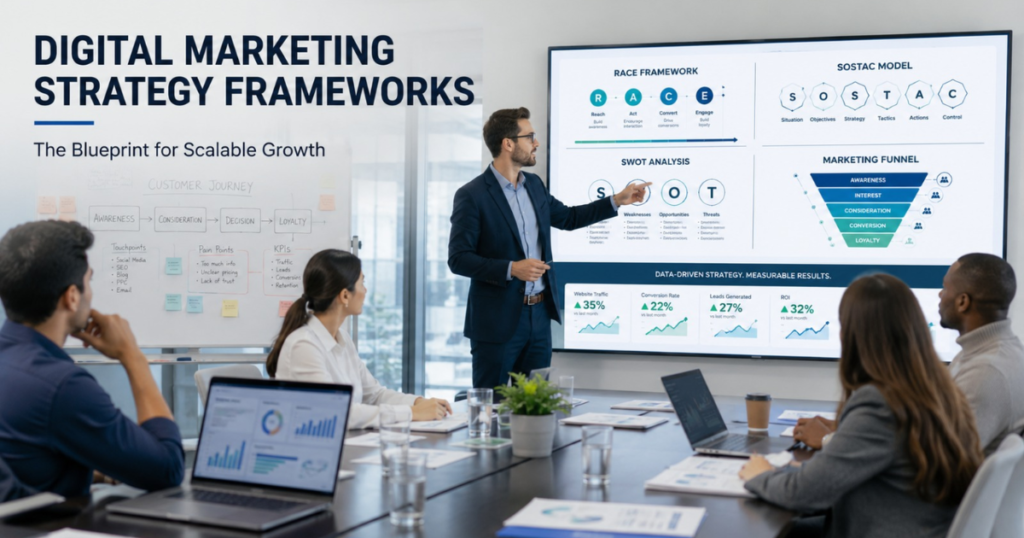
Why Marketing Fails Without a Framework Imagine building a house without a blueprint. You might lay a few bricks correctly, but the whole thing will eventually fall apart. That is exactly what happens when businesses run digital marketing without a clear strategy. You post on social media. You run a few ads. You write some blogs. But nothing connects. Nothing grows. The businesses that win online are not the ones spending the most money. They are the ones using a smart digital marketing strategy framework, a proven system that connects every action to a result. At Mark Mates, this is exactly how we work. Every strategy we build for clients is grounded in a structured framework that connects their business goals to their audience, their channels to their metrics, and their effort to measurable results. In this guide, you will learn what these frameworks are, which ones work best, and how Mark Mates uses them to drive scalable growth for businesses in 2026 and beyond. What Is a Digital Marketing Strategy Framework? A digital marketing strategy framework is a structured model that guides how a business plans and executes its marketing efforts. Think of it as a roadmap it shows you where you are, where you want to go, and the best route to get there. It connects three critical elements together: Without this connection, even the best marketing tactics waste time and budget. At Mark Mates, our entire approach is built on this principle. We do not run campaigns in isolation. We build data-driven marketing systems where every channel, every campaign, and every piece of content works together as one connected engine. Why Digital Marketing Frameworks Matter They Align Your Team Around One Direction When everyone on your team understands the framework, they stop working in silos. At Mark Mates, our collaborative approach ensures the paid media team, the content team, and the automation team all move toward the same business goals because they are operating from the same strategic blueprint. They Enable Data-Driven Decision Making Frameworks are built around measurable outcomes. Instead of guessing what works, you track real KPIs conversion rates, customer acquisition cost, ROI and make smarter decisions based on actual data. This is why Mark Mates installs Performance Tracking Systems into every engagement from day one. They Improve Customer Experience A good framework maps the full customer journey. That means showing up at the right place, at the right time, with the right message. This improves engagement, trust, and long-term loyalty which is precisely what our 360 Marketing Solutions are designed to deliver. They Prevent Costly Gaps Without a framework, it is easy to invest heavily in one channel while completely ignoring another. Our integrated approach at Mark Mates ensures full coverage from brand positioning and paid media through to conversion optimisation and retention. Understanding the Customer Journey Before choosing a framework, you need to understand how your customers think and behave. The buyer journey is the path a person takes from first learning about your brand to becoming a loyal customer. It moves through key stages: Every stage involves multiple touchpoints, the specific moments where your brand connects with the customer. At Mark Mates, our Funnel Conversion Optimisation service maps every one of these touchpoints and fixes the gaps that cause customers to drop off. Top Digital Marketing Strategy Frameworks 1. RACE Framework Developed by Smart Insights, the RACE Framework covers the full customer lifecycle in four stages: RACE maps directly to measurable KPIs at every stage, which is why Mark Mates uses this model as a core execution framework for ongoing campaign management. It aligns perfectly with our Performance Marketing and Social Media Growth services. 2. The Marketing Funnel The classic marketing funnel remains one of the most widely used models in the world. It narrows a large audience into paying customers through Awareness → Interest → Consideration → Action. It is simple, visual, and easy to communicate across teams. At Mark Mates, we pair the funnel with a retention model, because growth does not stop at the point of sale. Our 360 Marketing Solutions are specifically designed to cover both acquisition and retention in one connected system. 3. The Flywheel Model Introduced by HubSpot, the Flywheel replaces the traditional funnel with a circular model: Attract → Engage → Delight. In this model, happy customers become promoters who fuel new growth by referring others. This model underpins the way Mark Mates thinks about long-term brand growth. Our Content and Social Marketing and Brand Positioning Systems are built to delight customers at every stage — so your brand keeps growing through referrals and loyalty, not just ad spend. 4. McKinsey Consumer Decision Journey McKinsey’s model reflects the non-linear way modern buyers actually behave researching, revisiting, comparing, and looping back before they buy. It maps: Trigger → Consideration Set → Evaluation → Purchase → Post-Purchase → Loyalty Loop. This is especially valuable for Mark Mates clients in B2B, SaaS, and high-consideration industries. Our GTM and Brand Development service is built around understanding and shortening this decision journey with the right messaging at every stage. 5. SWOT Analysis SWOT stands for Strengths, Weaknesses, Opportunities, and Threats. It is a situational analysis tool used at the start of any strategy process. Before Mark Mates selects channels or tactics for a client, a SWOT analysis identifies the competitive position and real market opportunities. 6. PESTLE Analysis PESTLE Political, Economic, Social, Technological, Legal, and Environmental, helps marketers anticipate external forces that could impact strategy. At Mark Mates, this macro-level analysis ensures our strategies are built to remain resilient as market conditions evolve. 7. Porter’s Five Forces Michael Porter’s Five Forces model analyses competitive intensity in your market. It is a gold-standard tool for competitive analysis and helps businesses find sustainable market positioning which is foundational to the Brand Positioning Frameworks Mark Mates builds for clients. 8. SOSTAC Model Created by PR Smith, SOSTAC is one of the most complete planning frameworks available: SOSTAC is the backbone of how
Top Digital Marketing Mistakes Businesses Keep Making in 2026
There is very little doubt that businesses are operating in an increasingly complex digital landscape as we move through 2026. Technology is reshaping how consumers search, evaluate, and make purchasing decisions at a pace that makes last year’s playbook feel outdated. AI-powered search results, third-party cookie deprecation, and increasingly sophisticated buyers have raised the standard for what effective digital marketing actually looks like. According to HubSpot’s 2026 Marketing Report, 63% of businesses report that generating traffic and qualified leads remains their single biggest challenge, yet the majority are still making foundational digital marketing mistakes that directly cause that problem. From undefined target audiences and inconsistent branding to ignoring AEO and GEO optimization for AI-powered search tools, these errors compound quietly until they become structural revenue problems. The good news: every mistake in this guide is diagnosable, fixable, and preventable. Here is exactly where businesses are going wrong, and what to do instead. What Strategy Mistakes Kill Marketing Performance Before It Starts? Mistake 1: Not Defining a Clear Target Audience Every digital marketing mistake starts somewhere, and for most businesses it starts here. Marketing to everyone is the fastest way to reach no one. Without a defined ideal customer profile, built from real behavioral data, not demographic assumptions, every campaign, every piece of content, and every ad dollar operates at a fraction of its potential efficiency. In 2026, AI-powered targeting systems have made audience precision more achievable than ever. But those systems require clean input signals to produce accurate outputs. If your CRM contains vague or incomplete customer data, even the most sophisticated algorithm cannot compensate for the strategic failure of not knowing exactly who you are trying to reach. The fix is straightforward: build your ideal customer profile from your best existing customers not from who you wish would buy from you. Analyze behavioral patterns, purchase triggers, objection history, and content engagement before writing a single word of marketing copy. Mistake 2: Chasing Attention Without Understanding Buyer Intent Impressions are not interesting. Clicks are not commitment. One of the most expensive marketing strategy mistakes businesses make is optimizing for attention metrics, views, followers, reach, without aligning content and campaigns to actual buyer intent signals. Google processes over 8.5 billion searches per day. The businesses appearing at the top of those results are not just ranking for keywords, they are precisely matching the intent behind each query. Answer Engine Optimization and Generative Engine Optimization are the frameworks that bridge attention and intent in an AI-search world. Businesses ignoring them are producing content that gets seen but never acted on. Mistake 3: Treating Digital Marketing as a Short-Term Fix Short-term thinking is one of the most costly digital marketing errors a business can make and one of the most common. Marketing is not a switch you flip when revenue dips. It is a compounding system that builds momentum over time. According to data from the Content Marketing Institute, content marketing campaigns take an average of six to nine months to generate measurable organic traction. Businesses that abandon campaigns after 60 days because results are not immediate are not failing at marketing, they are failing at patience. They are also guaranteeing that the competitors who stay consistent will capture the compounding returns they walked away from. Mistake 4: Assuming More Platforms Means Better Marketing Being everywhere sounds strategic. In practice, it dilutes focus, fragments messaging, and produces mediocre performance across every channel instead of excellent performance on the right ones. The mistake of platform proliferation is especially common in early-stage companies trying to establish presence quickly. The discipline of choosing two or three channels where your target audience is genuinely active, and executing on those with depth and consistency consistently outperforms the spray-and-pray approach of posting on every available platform with minimal strategy behind any of them. What Branding and Content Mistakes Destroy Trust? Mistake 5: Inconsistent Branding Across Platforms Trust is built through repetition. When your brand looks, sounds, and feels different across your website, social media profiles, email campaigns, and paid ads, you are not just creating visual inconsistency, you are actively undermining the psychological familiarity that drives purchasing decisions. Research from Lucidpress found that consistent brand presentation across all platforms increases revenue by up to 23%. In 2026, with buyers encountering a brand across an average of seven touchpoints before converting, branding consistency is not a design preference, it is a revenue strategy. Mistake 6: Prioritising Virality Over Brand Trust Chasing viral content is one of the most seductive content marketing mistakes a brand can make. Viral moments are unpredictable, short-lived, and frequently attract audiences with zero purchase intent. Worse, viral content built on trends rather than brand values often attracts backlash that damages the trust you spent months building. The brands winning in 2026 are not the most viral. They are the most consistently credible publishing content that demonstrates genuine expertise, addresses real customer problems, and builds the kind of trust that makes a buyer choose you over a competitor when the moment of decision arrives. Mistake 7: Ignoring Long-Term Content Marketing Long-term content marketing is the highest-returning investment most businesses are undermaking. A well-researched, properly optimized article published today can generate qualified organic traffic for three to five years with no additional spend. Paid ads stop producing the moment the budget stops. Content compounds. According to Semrush, companies that publish 16 or more blog posts per month generate 3.5 times more traffic than those publishing four or fewer. The mistake of treating blogging as optional or secondary to paid media shows up consistently in the performance gaps between market leaders and the businesses trying to catch them. Mistake 8: Publishing Content Without SEO, AEO, and GEO Optimization Content without optimization is a tree falling in an empty forest. In 2026, publishing without SEO optimization, structured headings, keyword-aligned content, proper internal linking, schema markup, means Google cannot surface your content to the buyers actively searching for it. But the mistake most businesses are making right now goes deeper:
How Artificial Intelligence Is Changing the Future of Marketing
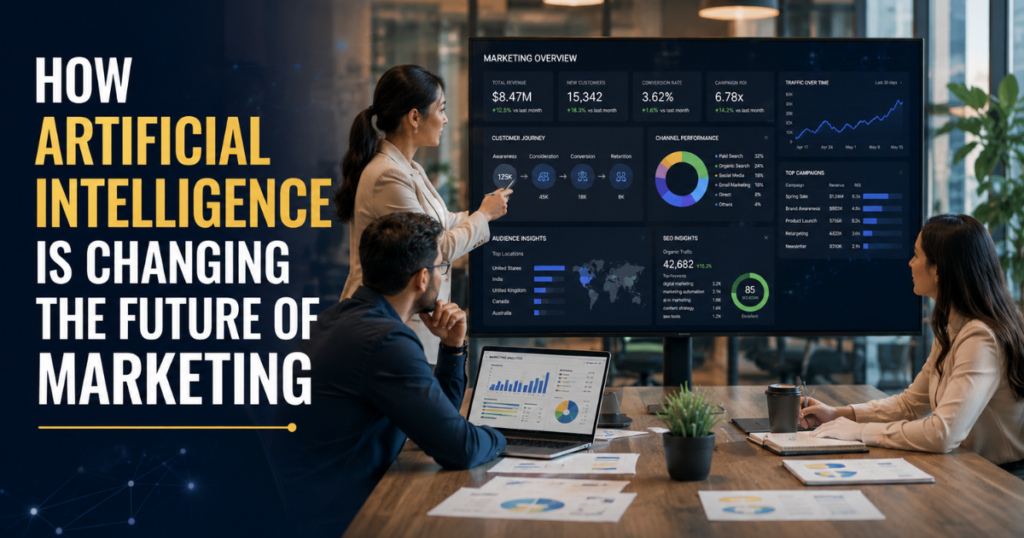
Introduction: Why Marketing Is Entering an AI-First Era Something fundamental has shifted in how businesses reach, convert, and retain customers. It isn’t a new platform or a new channel. It’s a complete rewiring of the underlying logic that marketing operates on. For decades, marketing ran on intuition backed by data. A team would form a hypothesis, build a campaign, run it for 30 days, measure results, and adjust. The cycle was slow, expensive, and deeply dependent on human bandwidth. The best marketers won by being more creative or more disciplined than their competitors. That model is being retired, not gradually, but quickly. Artificial intelligence isn’t entering marketing as another tool in the stack. It’s arriving as a transformation layer that sits beneath every function: how brands find customers, how they communicate, how they price, how they adapt in real time to shifting customer behavior. The companies that understand this early are building AI-driven systems that outperform traditional marketing operations at a fraction of the cost and a multiple of the speed. In 2026, the question is no longer whether AI will change marketing. It already has. The question is whether your organization is changing with it, or being left behind by those who are. What Is AI in Marketing? (Beyond the Buzzwords) Before going deeper, it’s worth being precise, because AI in marketing is one of the most misunderstood phrases in business today. Artificial intelligence in marketing refers to the use of machine learning models, natural language processing, computer vision, and predictive algorithms to automate decisions, generate content, personalize experiences, and extract insight from data at a scale no human team could match. That’s different from basic marketing automation, which follows pre-set rules. Automation sends an email when someone abandons a cart. AI decides which email, when to send it, what subject line will perform best for that specific user, and updates that logic continuously based on outcomes. Machine learning is the engine inside most AI marketing systems, it finds patterns in large datasets and improves its own predictions over time without being explicitly reprogrammed. The reason most marketers misunderstand AI is that they encounter it through surface-level tools, a chatbot, an image generator, a headline optimizer, without seeing the infrastructure underneath. AI in marketing, done properly, is a connected system of intelligence that gets smarter with every interaction. The Current State of AI in Marketing: 2026 Reality Check The current state of AI in marketing in 2026 is best described as uneven. The gap between early adopters and the rest of the field has never been wider. Leading brands using AI today are running fully autonomous campaign optimization, real-time audience segmentation, AI-generated creative variants tested at scale, and predictive churn models that flag at-risk customers before they disengage. In sectors like e-commerce, fintech, and SaaS, AI adoption is no longer a competitive advantage, it’s table stakes. But the majority of companies are still behind. Most are using AI as a point solution, a tool for writing copy faster or scheduling social posts, rather than as an integrated intelligence layer. AI adoption across industries remains patchy, with mid-market and enterprise organizations struggling most with integration, data quality, and internal change management. The companies that are pulling ahead share one characteristic: they didn’t bolt AI onto their existing marketing stack. They rebuilt their stack around AI. The AI Marketing Stack: Tools, Systems and Infrastructure The AI marketing stack in 2026 has four primary layers. The first is data infrastructure, the CRMs, CDPs, and data warehouses that feed clean, unified customer data into every other system. Without this foundation, AI tools produce noise, not insight. The second is AI-powered analytics and SEO tools, platforms that surface search intent, content gaps, audience behavior patterns, and competitive signals in real time. Tools in this layer include AI-driven keyword intelligence, predictive content scoring, and automated reporting systems. The third is execution tools, AI in content, AI in advertising, email personalization engines, and dynamic landing page systems. These are where generative AI is most visibly changing day-to-day marketing work. The fourth and most powerful is the AI agents layer. These are autonomous systems that can research, plan, execute, and optimize multi-step marketing workflows without constant human direction. The role of AI agents in modern workflows is expanding rapidly, with early adopters using them to run entire campaign cycles from brief to launch. Personalization at Scale: The End of Generic Marketing Hyper-personalized customer journeys were theoretically possible for years. In 2026, they’re operationally achievable for any company with the right infrastructure. AI-powered personalization works by processing behavioral data, browsing history, purchase patterns, content engagement, device usage, location signals, and dynamically assembling experiences that match individual intent. Not segments of thousands. Individual users. Dynamic content generation means a single email campaign can render differently for each recipient: different subject line, different product recommendation, different CTA, all generated and selected by AI in real time. Behavioral targeting using AI has also made demographic targeting look primitive by comparison. Age and location tell you very little. Behavioral signals, what someone searches at 11pm, what content they re-read, what they almost purchased, tell you everything you need to know about intent and timing. The era of generic marketing isn’t fading. It’s already over for the companies at the frontier. AI-Driven Content Creation and Generative Marketing Generative AI has fundamentally changed the economics of content production. What once required a team of writers, designers, and strategists working across weeks can now be produced, tested, and iterated across days. AI in content creation today spans blog articles, ad copy, email sequences, video scripts, social content, and product descriptions. The leading marketing teams aren’t using AI to replace their content function, they’re using it to multiply output without proportionally growing headcount. Generative AI in ads is particularly significant. Creative testing, which traditionally required budget, time, and manual analysis, can now run hundreds of variants simultaneously, with AI identifying winning combinations and reallocating spend automatically. The human and AI content system that works best