Automation & AI
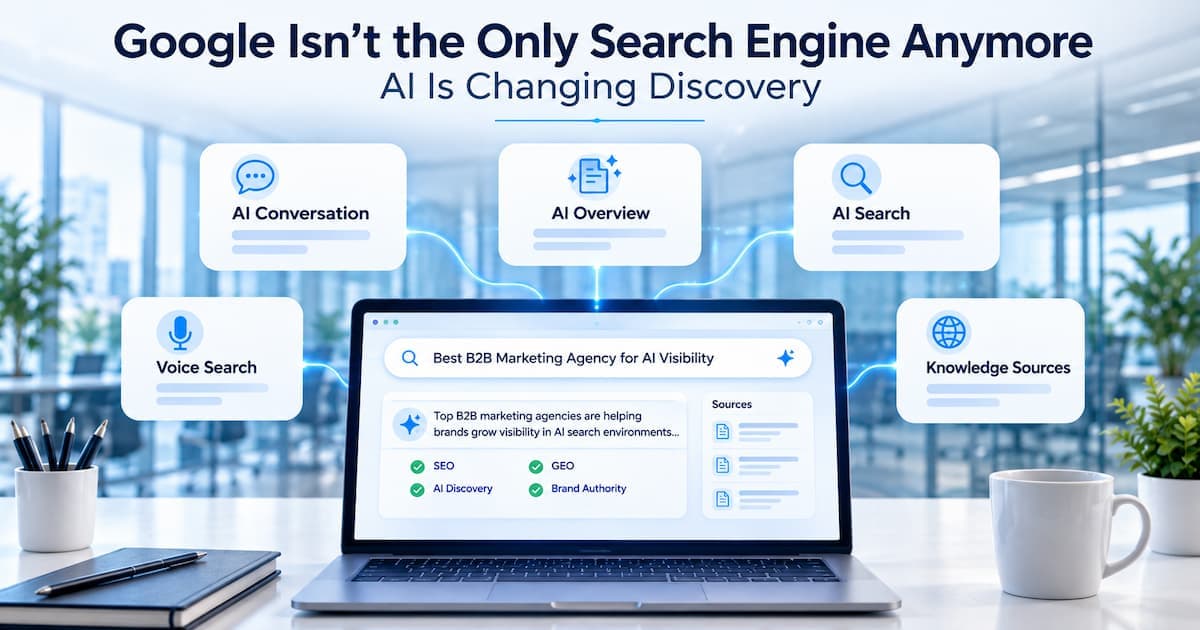
Google Isn't the Only Search Engine Anymore; AI Is Changing Discovery
Mark Mates Team
· 9 min read
Something significant is happening to the way people find information online.
For nearly two decades, digital discovery meant one thing: Google. Brands optimized for Google. Marketers tracked Google rankings. Business strategies were built around Google's algorithm updates. The entire discipline of SEO was, in practice, Google Search Optimization.
That era is not ending. But it is no longer the complete picture.
AI-powered search and discovery has created a parallel ecosystem of information retrieval that operates differently from traditional search engines and is growing in usage faster than most marketing teams have adjusted for. When a B2B decision-maker asks ChatGPT which content marketing agency to hire, or uses Perplexity to research brand strategy services, or reads a Google AI Overview that summarizes their query without showing them a list of links, the discovery moment has happened entirely outside the traditional search funnel.
At Mark Mates, we have been watching this shift closely and building the strategies that ensure our clients are visible across every discovery environment, not just the one that dominated the previous decade. The brands that understand this transition now are building visibility advantages that will be structurally difficult to replicate once the shift becomes obvious to everyone.
How AI Has Become a Primary Search and Discovery Tool
The numbers behind AI search adoption are significant and accelerating.
ChatGPT processes hundreds of millions of queries monthly. Perplexity has grown from a niche tool to a mainstream research platform used by enterprise decision-makers. Microsoft has embedded AI-generated answers into Bing at scale. And Google itself has deployed AI Overviews across a significant portion of search results, fundamentally changing what happens after a user types a query.
According to BrightEdge research, AI Overviews appear in approximately 47 percent of all search queries. For informational and research queries, the percentage is significantly higher. This means that for nearly half of all searches, the primary content a user sees is AI-generated text rather than a list of links to click through.
The behavioral implication is profound. A user reading an AI Overview is consuming synthesized information from multiple sources without visiting any of them. The brand whose expertise informed that synthesis has received a brand impression without the user ever touching their website. The brand absent from that synthesis has lost a discovery moment that no retargeting campaign can recover.
What Has Changed About Brand Discovery in the AI Era
Traditional search discovery followed a predictable path. A user typed a query. Google returned a ranked list. The user clicked a result. They visited a website. The brand had an opportunity to make an impression.
AI-powered discovery works differently at every step.
The query is often conversational rather than keyword-based. Instead of typing "content marketing agency B2B," a user might ask "what should I look for in a B2B content marketing partner and which agencies are known for that?" The AI interprets the intent, synthesizes relevant information, and delivers a generated response that may recommend specific brands, explain category differences, or summarize what experts in the field recommend.
No click is required. No website is visited. The brand impression is made through citation and recommendation within the AI-generated answer itself.
This is why Generative Engine Optimization has emerged as a distinct and essential discipline alongside traditional SEO. GEO addresses the specific requirements for appearing in AI-generated answers: topical authority, brand entity clarity, structured content, and external validation that AI systems use as credibility signals.
The Discovery Channels That Now Compete With Traditional Search
ChatGPT and Conversational AI Research
ChatGPT has become a research tool for business decision-makers across every industry. Users ask it to compare vendors, explain service categories, recommend specialists, and summarize what authoritative sources say about specific topics.
The brands that appear in ChatGPT recommendations have typically built the combination of content depth, external citation, and brand entity clarity that the model draws on when generating answers. This is not random. It is the result of deliberate brand authority investment made in environments that AI training data and retrieval systems can access and evaluate.
Perplexity and AI-Native Research Platforms
Perplexity operates as an AI-native search engine that generates cited, sourced answers rather than ranked link lists. Its user base skews heavily toward educated professionals and business decision-makers conducting serious research rather than casual browsing.
For B2B brands, appearing in Perplexity citations is a high-value discovery outcome because the audience conducting research there is precisely the audience making consequential purchasing decisions.
Google AI Overviews and Integrated AI Search
Google's own AI integration has created a new layer within traditional search that operates by different rules than organic ranking. Appearing in a Google AI Overview does not require ranking in position one for the underlying keywords. It requires being identified by Google's AI systems as a credible, authoritative, and accurately characterizable source for the topic.
This creates a new optimization target that sits alongside traditional SEO rather than replacing it: brands must now optimize for both the ranked results beneath the AI Overview and for the AI Overview itself.
Voice Search and AI Assistant Discovery
Voice search through AI assistants delivers single spoken answers rather than ranked lists. When a user asks their AI assistant for a recommendation, they receive one answer, not ten options. The brand that answers names is the brand that wins the discovery moment completely.
As AI assistant usage grows across smart devices, vehicles, and workplace tools, the single-answer format of voice search becomes an increasingly significant discovery channel for brands that have invested in the authority signals that determine which answer gets given.
Why Traditional SEO Alone Is No Longer Sufficient for Brand Visibility
Traditional SEO remains essential. Google processes billions of queries daily and organic search continues to drive significant website traffic and qualified pipeline for brands that have invested in ranking well.
But traditional SEO was designed to optimize for click-through to a website. The new discovery landscape includes an increasing number of moments where no click occurs, where the discovery happens entirely within an AI-generated interface, and where the brand impression is made through citation and recommendation rather than through a website visit.
A brand with strong traditional SEO but no GEO investment is fully visible in click-based search and invisible in the growing category of zero-click, AI-mediated discovery. As that category grows, the gap between brands optimizing for both and brands optimizing for only one widens proportionally.
The complete modern search visibility strategy requires:
- Traditional SEO for ranked organic positions and click-driven traffic
- GEO for AI-generated answer citations and recommendation visibility
- AEO for featured snippet presence and direct answer box eligibility
- Entity optimization for accurate brand representation in AI knowledge systems
- Content depth and authority for recognition across all AI discovery platforms
How Brands Can Optimize for AI-Powered Discovery
The brands most visible in AI-powered discovery environments share a consistent set of characteristics that can be built deliberately rather than accumulated accidentally.
Deep topical authority demonstrated through comprehensive content clusters covering their expertise area from multiple angles. AI systems recognize brands that have published authoritative, accurate, well-structured content across a topic consistently rather than brands that have published one or two pieces about many different subjects.
Clear brand entity definition with consistent information about who the brand is, what it does, and who it serves across every digital property. AI systems build their understanding of a brand from the aggregated signals across its entire digital footprint. Inconsistency creates the signal confusion that reduces citation probability.
External validation from credible sources: industry media mentions, review platform presence, analyst recognition, and citations by authoritative voices in the category. AI systems treat external validation as a credibility signal in the same way that search engines treat backlinks as an authority signal.
Structured content formatting that makes information extractable by AI systems: clear definitions, direct answers to specific questions, organized information hierarchies, and accurate factual content that AI systems can cite confidently.
FAQs About AI Search Discovery and Brand Visibility
How is AI-powered search discovery different from traditional Google search for B2B brands?
Traditional Google search returns a ranked list of links that users click through to websites. AI-powered discovery generates synthesized answers that deliver information directly, often without any click required. For B2B brands, this means discovery moments now occur in ChatGPT conversations, Perplexity research sessions, Google AI Overviews, and voice search responses where the brand impression is made through citation and recommendation rather than through a website visit. Brands visible in these environments build familiarity before any direct engagement begins.
What is generative engine optimization and why does it matter for brand discovery?
Generative Engine Optimization is the practice of building the brand signals that AI-powered search tools use to identify, characterize, and recommend brands when generating answers to user queries. It matters for brand discovery because AI-generated answers are becoming the primary content delivery format in a growing percentage of search interactions. Brands that appear in those answers are present at the earliest stage of the buyer research process. Brands absent from those answers are invisible during the moment when consideration sets are being formed.
How does a brand become visible in ChatGPT and Perplexity recommendations?
Visibility in ChatGPT and Perplexity recommendations comes from building the combination of topical authority, brand entity clarity, and external validation that these AI systems draw on when generating answers. Specifically: publishing comprehensive, accurate, well-structured content across your expertise area; maintaining consistent brand information across all digital properties; earning citations in credible industry publications and review platforms; and using content formats that AI systems can extract and reference cleanly. This visibility builds over three to nine months of consistent investment.
Should businesses still invest in traditional SEO if AI search is growing?
Yes, absolutely. Traditional SEO and AI search optimization are complementary rather than competing investments. Traditional SEO drives the click-based website traffic that remains a primary source of qualified pipeline for most businesses. AI search optimization ensures brand visibility in the growing category of zero-click, AI-mediated research that increasingly shapes buyer consideration sets before any website visit occurs. The brands building the strongest competitive positions invest in both simultaneously because they share foundational requirements including content quality, topical authority, and external credibility.
How does Mark Mates help businesses build visibility across both traditional and AI search environments?
Mark Mates builds integrated search visibility strategies that cover traditional SEO ranking, GEO optimization for AI-generated answers, AEO for featured snippet and direct answer eligibility, and brand entity optimization for accurate recognition across AI knowledge systems. Our approach ensures that client brands are visible in both the click-based search environments that drive direct traffic and the AI-mediated discovery environments where buyer research increasingly begins. For B2B businesses whose growth depends on being found before the sales conversation starts, Markmates provides the full-spectrum visibility strategy that covers every environment where that discovery is happening.
Conclusion: The Brands That Win Discovery Win the Conversation Before It Begins
The most valuable moment in any B2B sales process is the moment before the formal process begins, when a buyer is researching, forming opinions, and deciding which brands deserve their attention.
That moment is increasingly happening in AI-powered environments where Google is no longer the only search engine and where traditional SEO alone cannot guarantee visibility.
The brands that understand this shift and build their visibility accordingly are not just appearing in more search results. They are present at the precise moment when buyer consideration sets are being formed, building the familiarity and implied credibility that makes every subsequent interaction start from a stronger position.
At Mark Mates, we build the search visibility infrastructure that puts brands in front of buyers across every discovery environment they use, whether that is a traditional search result, an AI Overview, a ChatGPT recommendation, or a Perplexity citation.
Want to see if we're a fit?
Book a free call. We'll look at where your projects or marketing are getting stuck and tell you honestly whether we can help. No pressure either way.
Book your free strategy call