Automation & AI
AI Agents vs AI Automation: What's the Difference?
Team Mark Mates
· 10 min read
Two terms are dominating every serious conversation about business technology right now.
AI agents and AI automation are both being positioned as the future of business operations. Both involve artificial intelligence. Both promise efficiency gains. Both are being sold by vendors as solutions to operational complexity. And both are being confused with each other in ways that are causing businesses to make investment decisions that do not match their actual operational needs.
The confusion is understandable. The terms overlap in important ways. But they describe fundamentally different approaches to using AI in business operations, and choosing the wrong one for a specific use case produces disappointing results regardless of implementation quality.
At Mark Mates, we work with businesses navigating exactly this decision as they build the operational and marketing infrastructure for the AI era. The distinction between AI agents and AI automation is one of the most practically important clarifications we make with clients who are trying to understand where to invest and what to expect. This guide gives you that clarity.
What Is AI Automation?
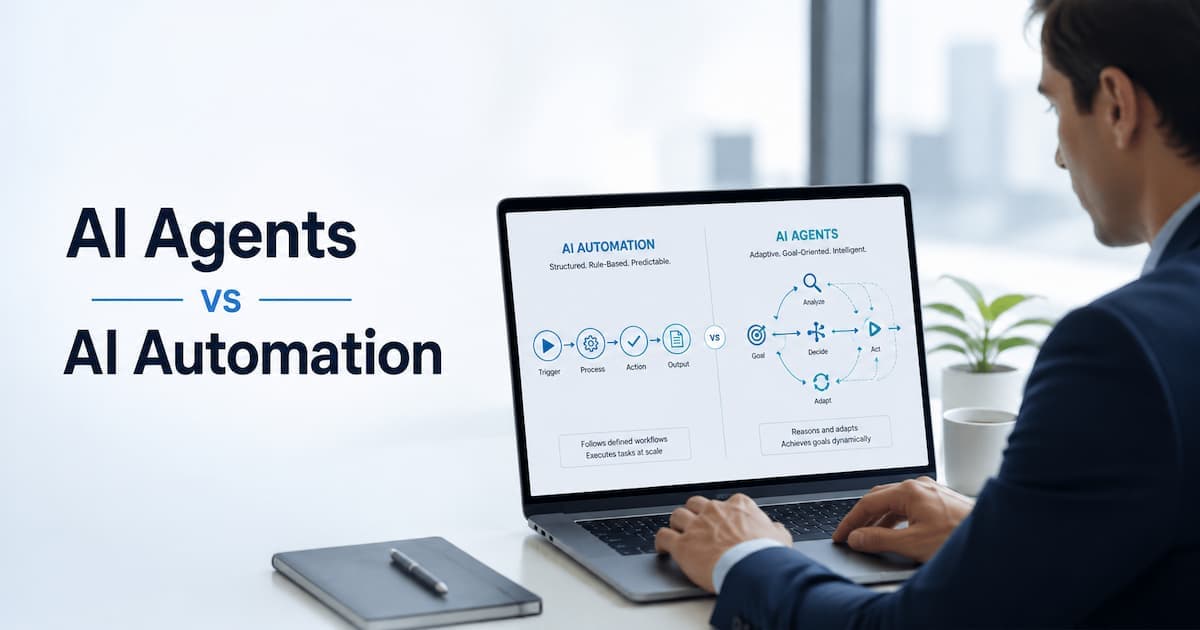
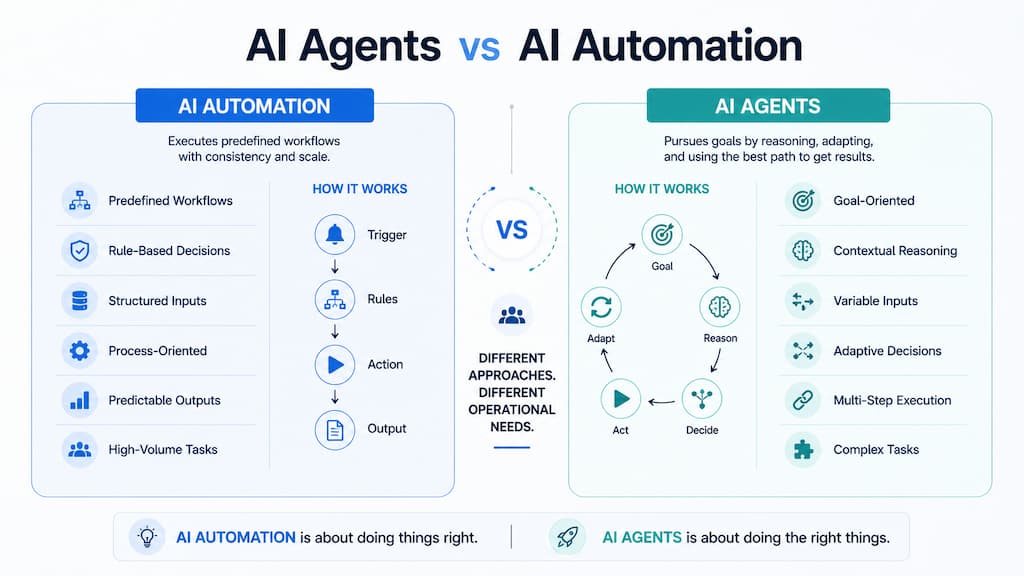
AI automation is the use of artificial intelligence to execute predefined workflows and processes without human intervention at each step.
It is the evolution of traditional rule-based automation, enhanced by AI capabilities that allow it to handle more complex inputs and make more nuanced decisions within a defined process boundary. Where traditional automation required exact trigger conditions and produced exact outputs, AI automation can handle variation in inputs, apply judgment within defined parameters, and produce outputs that adapt to the specific characteristics of each transaction.
A practical example: an AI automation system that processes incoming customer support tickets reads each ticket, categorizes it by issue type, assesses its urgency, and routes it to the appropriate queue. It does these things for every ticket, at any volume, without human involvement in the routing decision. But it is working within a defined workflow that was designed by humans, following a process logic that was established in advance.
AI automation excels at high-volume, structurally consistent processes where the variations are predictable enough to be accounted for in the workflow design. Invoice processing, data synchronization between systems, scheduled reporting, triggered communication sequences, and compliance monitoring are all strong applications for AI automation because they involve consistent inputs, defined decision rules, and predictable outputs.
The defining characteristic of AI automation is that it executes a designed process. It does not design or adapt the process itself. It makes the execution of defined workflows faster, more accurate, and more consistent, but the workflow design and the operational logic within it are established by humans.
What Is an AI Agent?
An AI agent is a system that receives a goal, determines its own approach to achieving that goal, uses tools and data to execute the necessary steps, adapts when conditions change, and delivers the outcome without requiring human direction at each stage of the process.
The critical distinction is that an AI agent reasons about what to do rather than following instructions about what to do. It receives an objective, not a script. It determines the path to that objective based on available information and tools. It handles unexpected situations through contextual judgment rather than predefined exception handling. And it can pursue complex, multi-step goals that involve variation and uncertainty that no predefined workflow could fully anticipate.
A practical example: an AI agent tasked with researching a prospective client before a sales meeting identifies the most relevant information sources for that specific prospect, searches across those sources, synthesizes what it finds into a structured briefing, cross-references recent news about the company, identifies the specific challenges relevant to the service being sold, and produces a personalized preparation document. Each step involves judgment about what matters for this specific prospect. No predefined workflow could capture all the variations that make one prospect's preparation fundamentally different from another's.
AI agents excel at tasks that involve variable inputs, require contextual reasoning, benefit from adaptive decision-making, and cannot be fully mapped in advance because the right approach depends on information discovered during execution.
The Core Differences: AI Agents vs AI Automation Side by Side
Understanding the practical differences between these two approaches requires looking at the specific dimensions where they diverge.
Input handling is the most fundamental difference. AI automation works best with consistent, structured inputs that fit within the parameters the workflow was designed for. AI agents can handle unstructured, variable, context-dependent inputs where the appropriate response depends on interpreting the specific situation rather than matching it to a predefined category.
Decision-making separates the two approaches clearly. AI automation makes decisions within defined parameters: if the input has these characteristics, take this action. AI agents make decisions through reasoning: given what I know about this situation, what approach is most likely to achieve the objective?
Adaptability distinguishes how each handles unexpected situations. AI automation typically has exception handling that routes unexpected inputs to human review. AI agents work through unexpected situations using contextual judgment, taking the actions that seem most likely to advance the goal based on available information.
Goal orientation reflects the fundamental architectural difference. AI automation is process-oriented: it executes a defined process efficiently. AI agents are goal-oriented: they pursue an objective using whatever approach the situation requires.
Human involvement in the design phase versus the execution phase also differs. AI automation requires significant human design investment upfront to map the workflow and define the decision logic. Once designed, it runs with minimal human involvement. AI agents require less upfront workflow design because they determine their own approach, but they typically require more ongoing human oversight to ensure they are pursuing objectives in ways that align with organizational intent.
When to Use AI Automation vs When to Use an AI Agent
The most practical question for business leaders is not which approach is better in general. It is which approach is appropriate for a specific operational need.
Choose AI automation when:
The process is high-volume and structurally consistent. When the same type of task occurs hundreds or thousands of times and the variations within it are predictable, AI automation produces reliable, scalable execution at low cost.
The decision rules can be defined explicitly. When the criteria for making decisions within a workflow can be captured in rules that cover the realistic range of scenarios, AI automation applies those rules consistently and accurately.
The output requirements are specific and verifiable. When the desired output of a process can be clearly specified and its quality can be objectively assessed, AI automation delivers that output reliably without the variability that comes with AI agent reasoning.
Compliance and auditability are critical. When every step of a process must be traceable and auditable, AI automation's rule-based execution provides the documentation trail that regulatory compliance requires.
Choose an AI agent when:
The task involves variable inputs that require contextual interpretation. When the right approach to a task depends on understanding the specific situation rather than applying a general rule, AI agent reasoning produces more appropriate outcomes.
The process cannot be fully mapped in advance. When the steps required to achieve a goal depend on information discovered during execution, AI agents can adapt their approach as new information emerges.
Complex multi-step research or synthesis is required. When a task requires gathering information from multiple sources, evaluating its relevance and credibility, and synthesizing it into an output tailored to specific requirements, AI agents handle the judgment involved in each step.
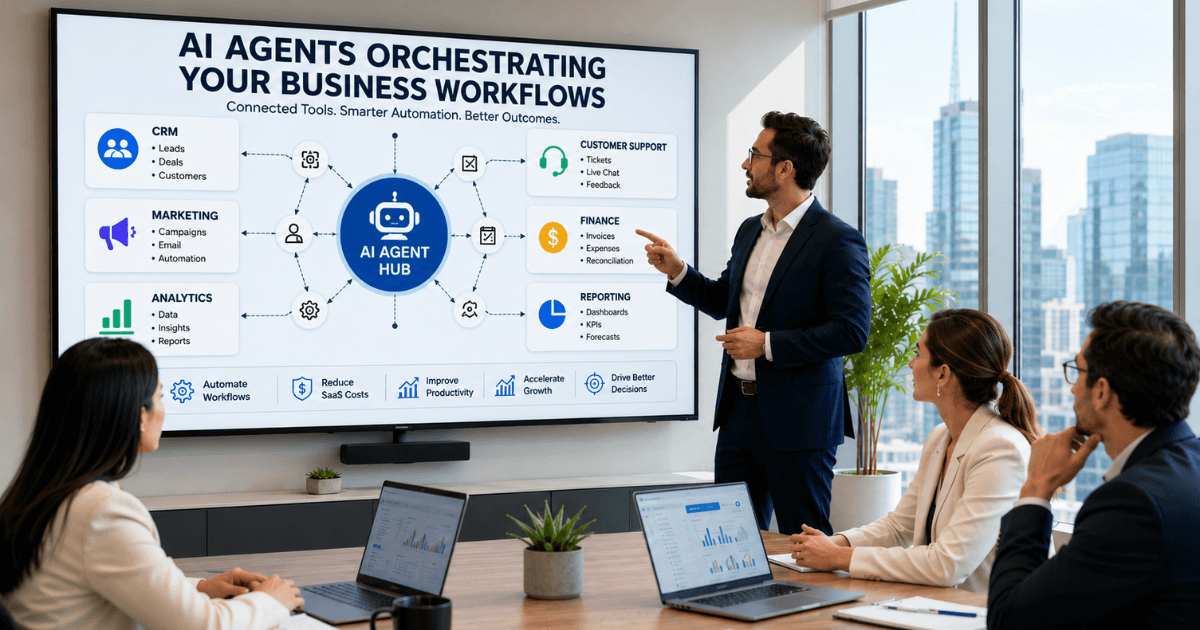
Cross-system orchestration requires adaptive coordination. When achieving a goal requires coordinating actions across multiple systems in ways that depend on the specific situation, AI agents navigate that coordination more effectively than predefined automation workflows.
Real Business Applications: Where Each Approach Delivers the Most Value
AI automation in practice is already transforming operational efficiency for the businesses using it most effectively. Finance teams using AI automation for invoice processing are handling the same volume with smaller teams and substantially lower error rates. Marketing teams using AI automation for lead nurturing are maintaining consistent, personalized communication with large prospect bases without proportional headcount increases. Operations teams using AI automation for reporting are receiving accurate, timely business intelligence without the data assembly labor that manual reporting requires.
AI agents in practice are producing results in the categories that require genuine reasoning. Sales teams using AI agents for pre-call research are entering customer conversations better prepared without spending the time that meaningful preparation previously required. Content teams using AI agents for competitive analysis are receiving synthesized intelligence about market positioning without the manual research hours that informed strategic decisions previously demanded. Customer success teams using AI agents for at-risk account identification are catching churn signals earlier because the agents can reason across multiple data signals in ways that rule-based monitoring cannot.
The most sophisticated business operations in 2025 are using both approaches: AI automation for the high-volume, defined process layer and AI agents for the variable, reasoning-intensive layer that surrounds and connects those processes.
FAQs About AI Agents vs AI Automation
What is the main difference between AI agents and AI automation for business operations?
AI automation executes predefined workflows efficiently, handling high-volume structured processes within rules established by human designers. AI agents pursue goals by reasoning about the best approach, handling variable tasks that require contextual judgment and adaptation. Automation is process-oriented and excels at consistency and scale. Agents are goal-oriented and excel at tasks requiring reasoning, variable inputs, and adaptive decision-making across complex multi-step scenarios.
Can businesses use AI agents and AI automation together in the same operations?
Yes, and the most effective AI operational architectures typically combine both. AI automation handles the high-volume, structurally consistent processes that form the operational backbone of the business. AI agents handle the variable, reasoning-intensive tasks that surround and connect those processes. A practical example is CRM operations where automation handles data synchronization and triggered communications while agents handle prospect research, personalization, and the adaptive tasks that benefit from contextual reasoning.
How do I decide whether my business needs AI agents or AI automation for a specific task?
The decision depends on the nature of the task. If the task is high-volume, structurally consistent, and can be mapped into defined decision rules, AI automation is the appropriate choice. If the task involves variable inputs, requires contextual interpretation, cannot be fully mapped in advance, or needs to adapt based on information discovered during execution, an AI agent is more appropriate. For most businesses, the answer will be both for different categories of work.
What are the security and governance considerations when using AI agents versus AI automation?
AI automation is generally easier to govern because its decision logic is explicit and auditable. AI agent decisions are more difficult to audit because they involve reasoning that may not be fully transparent. Both require appropriate permission management, access controls, and human oversight checkpoints. AI agents typically require more robust governance frameworks because their adaptive behavior creates a broader range of possible actions that need to be bounded by appropriate constraints and monitored through regular audits of agent behavior against expected outcomes.
How does Mark Mates help businesses implement the right combination of AI agents and AI automation?
Mark Mates works with B2B businesses to design AI operational architectures that match their specific workflow requirements, starting with a structured assessment of which processes benefit most from automation consistency and which benefit most from agent reasoning. Our approach covers workflow mapping and AI approach selection, implementation strategy for both automation and agent deployment, governance framework design, measurement infrastructure for outcome tracking, and the marketing strategy that communicates the operational capability built to potential clients. For businesses ready to move from ad hoc AI experimentation to strategic AI operational infrastructure, Markmates provides the architectural guidance and execution support that ensures the investment produces genuine business value.
Conclusion: The Right Tool for the Right Task
The question is never whether AI agents are better than AI automation or vice versa. Both are the right answer, for different types of tasks, in different operational contexts.
AI automation handles the volume, consistency, and reliability requirements that make routine business processes scalable and accurate. AI agents handle the reasoning, adaptability, and goal-orientation requirements that make complex, variable business tasks achievable at scale.
The businesses building the strongest operational advantage from AI are the ones that understand this distinction clearly enough to deploy each approach where it genuinely fits, rather than trying to solve every operational problem with a single AI strategy that is well-suited to some challenges and poorly suited to others.
At Mark Mates, we help businesses make this architectural decision with clarity, building the AI operational infrastructure that matches the right approach to the right need and produces compounding efficiency and capability over time.
Want to see if we're a fit?
Book a free call. We'll look at where your projects or marketing are getting stuck and tell you honestly whether we can help. No pressure either way.
Book your free strategy call