Marketing & SEO
The End of Random Marketing: Why Every Campaign Needs a System
Team Mark Mates
· 13 min read
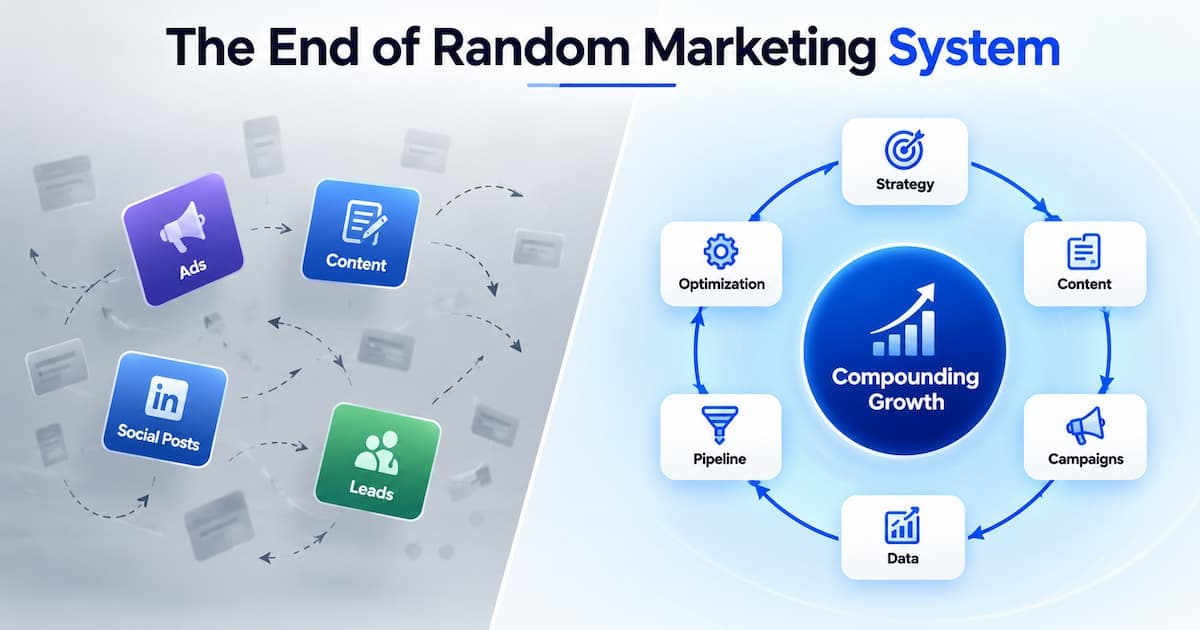
Most marketing budgets are not being wasted on bad ideas.
They are being wasted on good ideas executed without a system behind them.
A well-crafted campaign launches. It generates some engagement. It produces a few leads. And then it ends. The next campaign starts from scratch with a different message, a different creative direction, and a different set of assumptions about what the audience needs to hear. Three months later, the cycle repeats. The marketing team is busy. The output is visible. But the results never seem to compound the way the effort invested should produce.
This is random marketing. And it is the default operating mode for more businesses than most marketing leaders want to acknowledge.
At Mark Mates, we have worked with growth-stage businesses and established B2B organizations across industries and the pattern is consistent: the businesses that generate the most marketing ROI are not the ones running the most campaigns. They are the ones running campaigns inside a system that makes every piece of work build on the previous one, that captures what works and amplifies it, and that connects marketing activity to business outcomes in a way that improves with every cycle.
What Is Random Marketing and Why Does It Fail?
Random marketing is the pattern of executing marketing activities based on immediate opportunity, competitive pressure, or internal preference rather than on a coherent strategic system designed to produce specific business outcomes.
It shows up in recognizable ways. A competitor launches something new and the team rushes to respond with a similar piece of content. A trend appears on LinkedIn and the company produces a post about it because it feels timely. A campaign runs until the budget is spent, produces some activity metrics, and is replaced by a new campaign with a different theme because last quarter's approach felt stale.
None of these individual decisions are necessarily wrong. The problem is the absence of the system that would tell you which decisions actually move the business forward, which content assets are building authority that compounds over time, and which channels are producing pipeline rather than just impressions.
Random marketing has three specific failure modes that compound each other:
It fails to build brand authority. Brand recognition and authority are built through consistent, sustained presence on the topics that matter most to your target audience. Random campaigns on different themes do not accumulate into authority. They produce a brand that feels active but never becomes the definitive voice in any specific territory.
It fails to produce compounding returns. A well-designed marketing system produces assets that generate value long after the campaign that created them ends. A content cluster published on a validated topic continues to generate organic traffic, AI search citations, and inbound leads for years. A random blog post published because someone thought it was a good idea this week generates a spike of activity and then disappears.
It fails to produce learnable data. Marketing systems generate the data that makes future decisions more accurate: which messages convert, which channels reach buyers at the right stage, which content topics produce pipeline rather than pageviews. Random marketing generates data that cannot be interpreted meaningfully because the variables change with every campaign, making it impossible to determine what actually worked.
The Anatomy of a Marketing System That Actually Works
A campaign marketing system is the operational architecture that ensures every campaign serves a defined strategic purpose, connects to the campaigns before and after it, generates data that improves future performance, and builds brand assets that accumulate value over time.
It contains six connected components that must function as an integrated whole rather than as independent initiatives.
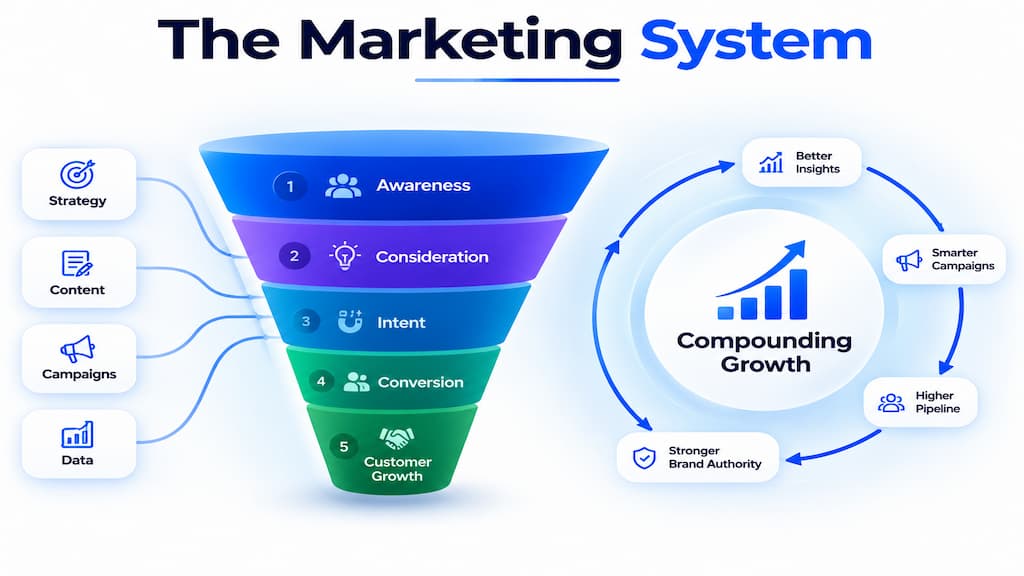
Strategic Foundation: ICP, Positioning, and Message Architecture
Every effective marketing system begins with strategic clarity that most random marketing operations never achieve: a validated ideal customer profile, a clearly differentiated positioning statement, and a message architecture that defines what the brand says, to whom, at which stage of the buying process, and through which channels.
This foundation is not created once and forgotten. It is the living reference document that every campaign is built from. When a new campaign is proposed, the first question is not "is this a good idea?" It is "does this serve the ICP we have validated, does it reinforce the positioning we have defined, and does it deliver the message that the audience needs at this stage of their journey?"
Campaigns built from a strategic foundation compound. They reinforce the same brand position consistently until it becomes the automatic association in the target buyer's mind. They address the same buyer's concerns from different angles until the cumulative case for choosing this brand becomes impossible to ignore.
Content Cluster Architecture and Topical Authority
The content component of a marketing system is built around topic clusters rather than individual pieces. A topic cluster is a group of content assets organized around a central pillar topic, with supporting content addressing the specific questions, subtopics, and buyer concerns within that territory.
Topic clusters do several things that random content cannot. They build the topical authority that search engines and AI systems use to identify credible sources. A brand with ten pieces of deeply relevant content on a specific topic is recognized as an authority by Google, Bing, and AI-powered search tools. A brand with one hundred random pieces on fifty different topics is recognized as active but not authoritative.
They also create a buyer journey within the content itself. A buyer who finds a piece of supporting content and follows internal links to the pillar content, then to related supporting pieces, is spending significantly more time with the brand's thinking before ever speaking to a human. That depth of pre-sales engagement produces buyers who are significantly warmer and better informed when they do reach out.
Lead Capture and Pipeline Architecture
A marketing system has defined mechanisms for converting the attention it generates into pipeline. This means lead capture assets specifically designed for different stages of the buyer journey, lead qualification frameworks that distinguish high-intent from low-intent engagement, and pipeline handoff processes that connect marketing-qualified interest to sales conversation without losing momentum.
Random marketing generates attention without a consistent mechanism for converting that attention into a trackable pipeline. The leads that do arrive cannot be attributed to specific activities, which makes it impossible to optimize the activities that produce them.
A systematic approach to lead capture means that every campaign has a defined conversion mechanism: a content asset that exchanges value for contact information, a CTA that routes buyer intent to the appropriate next step, or a direct response mechanism that captures interest while it is active rather than hoping the buyer will remember to search for the brand later.
Measurement Infrastructure and Attribution
The measurement layer is what transforms marketing from a cost center into a learnable system. Properly configured measurement infrastructure tracks which campaigns, channels, and content assets are generating not just engagement but pipeline and revenue, creating the data that makes every future campaign decision more accurate.
This requires more than Google Analytics. It requires closed-loop reporting that connects marketing activity to CRM pipeline to closed revenue. It requires attribution modeling that distributes credit across the multiple touchpoints that typically precede a B2B purchase decision. And it requires the discipline to measure the outcomes that matter, pipeline quality and velocity, customer acquisition cost, and marketing-attributed revenue, rather than the metrics that feel productive but do not connect to business results.
Campaign Sequencing and Nurture Architecture
A marketing system sequences campaigns deliberately rather than launching them independently. Each campaign serves a defined purpose in the buyer journey and connects to the next campaign through the data it generates and the pipeline it moves forward.
This sequencing operates at two levels. At the audience level, it means campaigns that build awareness among prospects who have not yet engaged, campaigns that deepen consideration among prospects who have shown initial interest, and campaigns that accelerate decision among prospects who have entered an active evaluation. At the asset level, it means each campaign creates the foundation that the next campaign builds on: the awareness campaign generates the content that the consideration campaign references, which generates the social proof that the decision campaign deploys.
Optimization Loops and Continuous Improvement
The final component of a marketing system is the process that makes it improve over time. A marketing system without optimization loops is a well-designed mechanism that plateaus rather than compounds.
Optimization loops operate at different time scales. Weekly optimization addresses tactical performance: which ad variations are converting, which email subject lines are opening, which content is generating the most time-on-page from ICP accounts. Monthly optimization addresses channel and message performance: which content topics are generating qualified pipeline, which channels are producing buyers with the highest lifetime value. Quarterly optimization addresses strategic questions: is the positioning resonating with the validated ICP, are the campaigns serving the right stage of the buyer journey, is the topic cluster authority building at the expected rate?
Why Systematic Marketing Outperforms Random Campaigns Every Time
The performance gap between systematic marketing and random campaign marketing is not marginal. It is structural.
A systematic approach compounds. Each campaign generates data that makes the next more targeted. Each piece of content builds the authority that makes the next piece more credible. Each buyer interaction adds to the understanding of what the audience needs, which makes the next campaign more relevant.
Random marketing resets. Each campaign starts from approximately the same knowledge base as the previous one because the learning from the previous campaign was not captured in a form that improves the next decision.
According to Content Marketing Institute research, businesses with a documented content marketing strategy consistently outperform those without one on every measurable outcome: traffic growth, lead quality, conversion rates, and customer acquisition costs. The performance gap is not explained by budget differences. It is explained by the compounding effect of systematic execution versus the static performance of random activity.
The Most Common Reasons Marketing Systems Fail to Get Built
Understanding why most businesses operate in random marketing mode rather than building the systems that would dramatically improve their results reveals the specific obstacles that need to be addressed.
Urgency bias. Marketing teams operate under constant pressure to produce output. Building a system requires upfront investment in strategy, architecture, and measurement before the first campaign launches, which feels slow when leadership is expecting to see results now. The businesses that break this pattern are those with leadership that understands the difference between activity and compounding output.
Attribution complexity. B2B marketing attribution is genuinely difficult. Multiple touchpoints precede most purchase decisions, the sales cycle is long, and the relationship between specific marketing activities and closed revenue is not always visible. Many teams default to measuring what is easy to measure rather than investing in the infrastructure that would reveal what actually works.
Tool proliferation without integration. Many marketing teams have accumulated tools for content management, email marketing, CRM, analytics, paid advertising, and social management that do not share data effectively. Building a marketing system requires connecting these tools into an integrated data layer, which is a technical investment that gets deprioritized when the team is occupied with campaign execution.
Lack of strategic clarity upstream. A marketing system cannot be built without validated ICP definition, positioning clarity, and message architecture. Many marketing teams are executing campaigns without this foundation because the business has never completed the foundational positioning work that campaigns should be built from.
Building Your Marketing System: Where to Start
The businesses that successfully transition from random marketing to systematic marketing follow a consistent starting sequence.
Complete the foundational positioning work first. Define the ICP based on behavioral data from your best existing customers. Document the positioning that differentiates the brand specifically from alternatives the ICP is actually considering. Build the message architecture that defines what the brand says at each stage of the buyer journey. This work creates the foundation that every subsequent system component is built from.
Build the measurement infrastructure before the next campaign. Configure closed-loop reporting that connects campaign activity to CRM pipeline to revenue. Define the metrics that reveal whether marketing is producing business outcomes rather than just activity. Establish the baseline against which future performance will be measured.
Design the content cluster for one core topic area. Select the topic where the brand has the deepest expertise and the most direct connection to buyer intent. Build the pillar content and supporting cluster content for that territory before expanding to adjacent topics. This builds the topical authority foundation that all future content investments extend.
Sequence the next three campaigns from the strategic foundation. Rather than planning campaigns independently, design the next three as a sequence that serves different stages of the buyer journey for the validated ICP. Define the conversion mechanism, the attribution tracking, and the optimization questions for each before execution begins.
FAQs About Building a Systematic Marketing Strategy
What is the difference between random marketing and systematic campaign marketing?
Random marketing executes campaigns based on immediate opportunity or internal preference without a coherent strategic architecture connecting them. Systematic marketing builds each campaign from a validated strategic foundation, sequences campaigns to serve different stages of the buyer journey, captures the data from each campaign to improve the next, and accumulates brand authority and pipeline assets that compound over time. The performance gap between the two approaches is structural rather than marginal because systematic marketing improves with every cycle while random marketing resets.
Why does content marketing work better with a topic cluster strategy than with individual posts?
Topic cluster strategies outperform individual content approaches because they build topical authority that search engines and AI systems recognize as expertise rather than activity. A brand with ten deeply relevant, interconnected pieces on a specific topic earns recognition as an authoritative source that drives both organic ranking improvements and AI search citation probability. Individual posts on different topics produce isolated engagement without accumulating the authority signals that create compounding discovery over time. Topic clusters also create a buyer journey within the content itself that produces significantly warmer prospects by the time they engage with sales.
What metrics should B2B marketing teams track to evaluate system performance?
The metrics that reveal whether a marketing system is producing genuine business value are outcome metrics rather than activity metrics: marketing-attributed pipeline as a percentage of total pipeline, cost per qualified lead by channel and campaign type, lead-to-opportunity conversion rate by content source, customer acquisition cost trend over time, and time-to-close comparison between marketing-sourced and other pipeline sources. These metrics connect marketing activity to business outcomes and reveal whether the system is improving with each optimization cycle.
How does Mark Mates help B2B businesses build marketing systems that replace random campaign marketing?
Mark Mates works with B2B marketing leaders and founders to build the complete marketing system architecture that turns campaign activity into compounding results. Our approach covers foundational ICP validation and positioning strategy, topic cluster design and content architecture, lead capture and pipeline mechanism development, measurement infrastructure and closed-loop attribution setup, campaign sequencing for the full buyer journey, and the optimization process framework that makes the system improve over time. For marketing teams whose results are not compounding despite consistent effort, Markmates provides the systems diagnosis and architecture that addresses the structural gaps producing that outcome.
Conclusion: The System Is What Makes Marketing Worth Investing In
Every business that has built a marketing operation that genuinely compounds its results has done so by replacing random campaign marketing with systematic campaign marketing.
Not by spending more. Not by hiring more. By building the architecture that makes every campaign serve a larger purpose, generate learnable data, and create brand assets that accumulate value long after the campaign itself has ended.
The end of random marketing is not a loss of creativity or spontaneity. It is the decision to make creativity and strategic insight more effective by giving them a system to operate within. The most creative campaign executed without a system to build on produces a spike. The same creative campaign executed within a system that amplifies it, sequences it correctly, captures what works, and builds on the authority it creates produces compounding returns that no isolated campaign can match.
At Mark Mates, we build the marketing systems that make this transition from random activity to compounding results genuinely achievable for the B2B brands serious about making their marketing investment work harder.
Want to see if we're a fit?
Book a free call. We'll look at where your projects or marketing are getting stuck and tell you honestly whether we can help. No pressure either way.
Book your free strategy call