Automation & AI
The New Business Stack: AI Agents, Automation, and Human Decision-Making
Team Mark Mates
· 12 min read
The way businesses operate has fundamentally changed in the last eighteen months.
Not incrementally. Not through a gradual evolution of existing tools and practices. Through a structural shift in what a business operation can look like when AI agents, intelligent automation, and human decision-making are combined in the right configuration.
The businesses at the front of this shift are not just more efficient. They are operating with a different relationship between human effort and business output. A team of ten people with a well-configured new business stack can execute the operational volume that previously required thirty or forty, while the human members of that team spend their time on the strategic, creative, and relational work that genuinely requires human judgment.
At Mark Mates, we work with growth-stage businesses and enterprise teams building this new operational model. The patterns we see consistently in the organizations getting this right, and the mistakes we see in those struggling with it, have shaped everything in this guide.
What Is the New Business Stack?
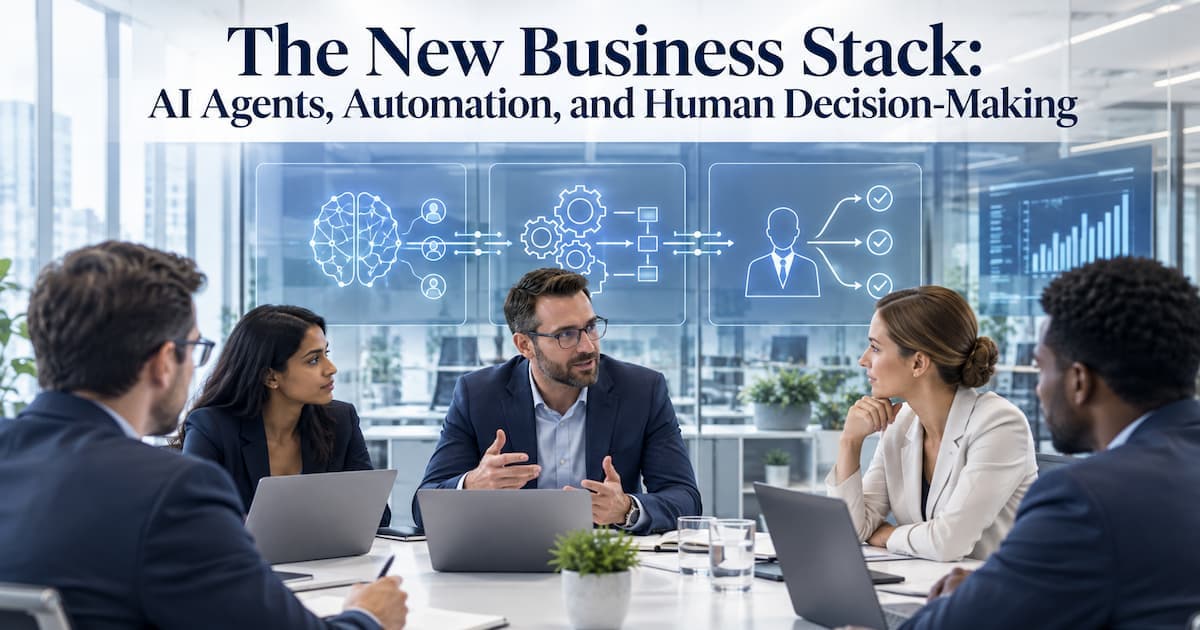
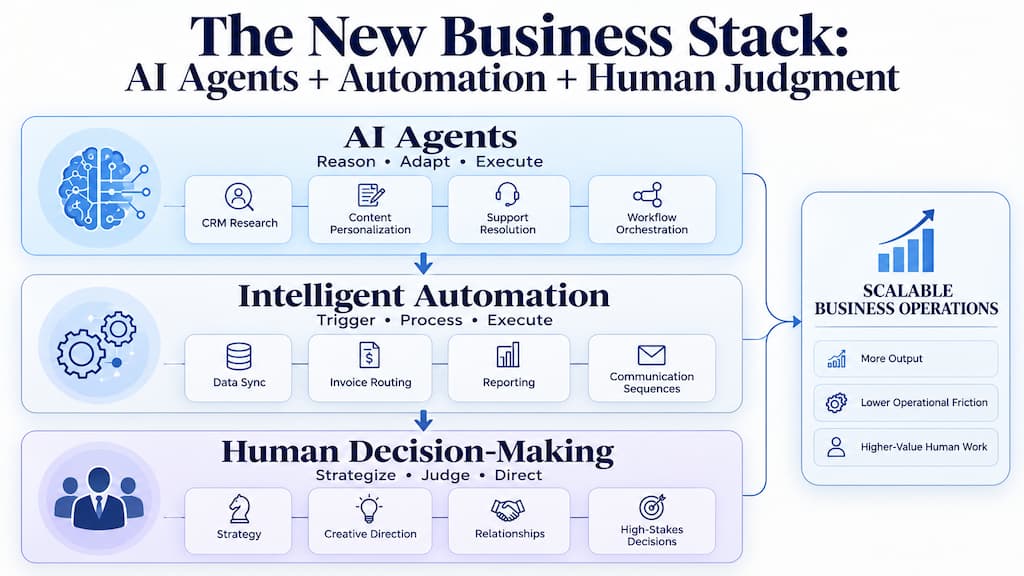
The new business stack is the combination of three interconnected layers that define how modern businesses execute their operations: AI agents that handle autonomous task execution, intelligent automation that manages defined workflow processes, and human decision-making that provides strategic direction, judgment, and the contextual wisdom that no system can yet replicate.
Each layer has a distinct role. Understanding that distinction is the foundation of building a stack that compounds rather than confuses.
AI agents are autonomous systems capable of receiving a goal, planning the steps to achieve it, using tools and data to execute those steps, and adapting when conditions change. They handle the multi-step, variable, context-dependent tasks that traditional automation cannot manage: CRM research and enrichment, content personalization at account level, support ticket resolution with contextual judgment, and intelligent workflow orchestration across multiple systems.
Intelligent automation handles the high-volume, structured, rule-following processes that occur consistently enough to be defined explicitly: invoice routing, scheduled reporting, data synchronization between platforms, triggered communication sequences, and compliance monitoring. It executes reliably at scale without requiring reasoning because the process it follows has been designed to handle the scenarios it encounters.
Human decision-making is the strategic layer that the other two exist to serve. Humans set the objectives. Humans define the parameters within which AI agents and automation operate. Humans evaluate outcomes and make the adjustments that compound the system's performance over time. And humans handle the situations that fall outside defined parameters: the high-stakes relationship decision, the novel strategic challenge, the ethical judgment call, and the creative direction that gives the automated outputs meaning and purpose.
The new business stack works when these three layers are integrated deliberately. It fails when they are treated as independent investments rather than as a unified operational architecture.
Why This Shift Is Happening Now
The timing of this transition is not accidental. Three forces have converged to make the new business stack not just possible but commercially necessary for businesses competing in the current environment.
Foundation Model Reliability Has Crossed the Enterprise Threshold
Earlier generations of AI tools were impressive in demonstration and inconsistent in production. The models available today have achieved the reasoning depth, tool-calling accuracy, and context-handling reliability that enterprise workflows require. Businesses that deployed AI agents two years ago and found them unreliable are discovering that the same use cases are now performing dependably at production scale.
The Cost of Manual Operations Has Become Uncompetitive
The fully-loaded cost of manual operational execution, including labor, error remediation, coordination overhead, and the opportunity cost of skilled people doing low-value tasks, has become a structural disadvantage for businesses competing against organizations that have automated the same functions. The cost gap between AI-augmented operations and purely manual operations is widening faster than most businesses that have not yet made the transition realize.
The Talent Market Has Shifted Expectations
The most capable operations and marketing professionals in the current market expect to work with intelligent tools rather than against manual processes. Organizations that cannot offer an AI-augmented working environment are finding it harder to attract and retain the talent that makes the human decision-making layer genuinely valuable.
The 5 Business Functions Being Transformed by the New Stack
Revenue Operations and Pipeline Management
Revenue operations is the business function that benefits most immediately and most visibly from the new business stack. The combination of AI agents handling CRM enrichment, lead research, and pipeline monitoring with automation managing follow-up sequences and reporting, while human sales leaders make the strategic account decisions and relationship judgments, creates an operational model where the revenue team punches dramatically above its headcount weight.
AI agents in revenue operations monitor target accounts for intent signals, surface changes in stakeholder composition, research prospects before outreach, personalize communications at account level, update pipeline records based on engagement data, and generate deal summaries that give human sales leaders the context they need to make informed decisions quickly.
The human sales professional in this model is not doing less work. They are doing more impactful work: spending their full capacity on the conversations, relationships, and judgment calls that genuinely differentiate their contribution from what the system handles autonomously.
Marketing Execution and Content Operations
Marketing has historically been constrained by content production bandwidth. The volume of assets required to run campaigns across multiple channels, to personalize content for different audience segments, and to maintain consistent brand presence at the frequency modern algorithms reward has always exceeded what human creative teams can produce within reasonable budgets.
The new business stack removes this constraint. AI agents handle content research, first-draft production, variation generation for A/B testing, performance analysis, and the synthesis of insights from multiple data sources. Intelligent automation manages publication schedules, audience segmentation, campaign triggers, and cross-platform distribution. Human marketers direct the strategy, define the creative brief, apply the brand judgment that AI cannot replicate, and make the channel and messaging decisions that require understanding of market context.
The output is marketing operations that produce significantly more content, more personalization, and more performance data than the same team could generate manually, while the human creative and strategic contribution is elevated rather than diminished.
Customer Support and Experience Management
Customer support is one of the most resource-intensive functions in B2B operations and one of the most directly connected to retention outcomes. The new business stack transforms support from a headcount-dependent function to an intelligence-dependent one.
AI agents handle first and second-tier support resolution: reading the customer's history, understanding the issue context, accessing relevant knowledge and system data, and delivering accurate resolutions without queue time or human routing delays. Automation manages the routing, escalation triggers, satisfaction surveys, and follow-up communications that surround each support interaction. Human support specialists handle the genuinely complex situations: the emotionally sensitive relationship issue, the novel technical problem, the strategic account escalation that requires judgment and relationship authority.
The customer experience outcome is faster resolution times, more consistent service quality, and human specialist attention directed to the interactions where it creates the most value.
Finance Operations and Compliance Management
Finance operations represent one of the most straightforward applications of the new business stack because financial processes are typically well-defined, data-rich, and high-volume. Invoice processing, payment routing, expense categorization, compliance monitoring, and financial reporting are all strong candidates for intelligent automation with AI agent oversight.
AI agents in finance operations read and extract data from incoming documents, cross-reference against existing records and contract terms, identify discrepancies that require human review, and generate the analysis that supports financial decision-making. Automation executes the defined approval workflows, payment schedules, and reporting cycles. Human finance leaders make the strategic financial decisions, manage the banking and vendor relationships, and handle the exceptions that fall outside defined parameters.
The accuracy improvement from removing manual data entry from financial workflows is as commercially significant as the time saving. Manual data entry error rates in financial processes consistently run between one and three percent. Each error generates remediation work that multiplies the original processing cost significantly.
Strategic Intelligence and Market Analysis
The application of the new business stack that has the highest long-term strategic value is also the one least commonly implemented: using AI agents to continuously synthesize market signals, competitive intelligence, customer behavior patterns, and operational performance data into the strategic intelligence that leadership uses to make consequential decisions.
AI agents monitoring competitive positioning, customer sentiment, market trend signals, and internal performance metrics can surface insights at a speed and comprehensiveness that no human analytical team can match. The synthesis happens continuously rather than in monthly reporting cycles, meaning leadership makes decisions with information that reflects current reality rather than last month's snapshot.
This is not AI replacing strategic judgment. It is AI providing the information environment that makes human strategic judgment significantly more accurate and more timely.
Building the New Business Stack: The Right Sequence
The most common failure mode in new business stack implementation is attempting to build everything simultaneously. Organizations that try to deploy AI agents, revamp automation infrastructure, and retrain their teams all at once typically end up with integration complexity that exceeds their capacity to manage it, and results that fall short of what a more sequenced approach would achieve.
The sequence that consistently works:
Start with data infrastructure. AI agents and intelligent automation are only as reliable as the data they operate on. Before deploying any AI capability, invest in clean, connected, accessible operational data. A CRM with inconsistent records, disconnected systems with no API integration, and reporting built on manually assembled spreadsheets will produce unreliable AI outputs regardless of how sophisticated the agent layer above it is.
Automate one defined workflow at a time. Select the single highest-volume, most structurally consistent workflow in the business and build reliable automation for that specific process before moving to the next. This builds organizational confidence, reveals the edge cases that require governance attention, and produces measurable results that justify continued investment.
Layer AI agents onto automated foundations. Once clean automation is running reliably for defined workflows, AI agents can be deployed to handle the variable, context-dependent tasks that surround those workflows. The combination of reliable automation for structured processes and AI agents for variable tasks creates the operational architecture that genuinely compounds.
Build governance alongside capability. Every AI agent deployment requires defined human checkpoint moments, exception escalation paths, and regular audit processes that verify the system is performing as intended. Governance is not a constraint on capability. It is the infrastructure that allows capability to expand safely over time.
Measure outcomes not activity. The metrics that reveal whether the new business stack is creating genuine business value are outcome metrics: time freed per workflow, error rate reduction, conversion rate improvement, customer satisfaction change, and the human capacity redirected to higher-value work. The volume of automated transactions is activity, not value.
The Human Role in an AI-Augmented Business
The most important strategic question in the new business stack transition is not which tasks AI agents should handle. It is what humans should do with the capacity that AI and automation free.
The answer defines whether the new business stack creates genuine competitive advantage or merely operational efficiency.
Businesses that use automation savings primarily to reduce headcount may achieve short-term cost reduction. Businesses that use automation savings to redirect human capacity toward higher-value strategic, creative, and relational work build the compounding advantage that is genuinely difficult for competitors to replicate.
The human skills that become more valuable in an AI-augmented business, not less, are strategic judgment, creative direction, relationship management, ethical reasoning, contextual wisdom, and the ability to direct and evaluate AI systems effectively. These are not niche capabilities. They are the core of what makes the human contribution to a business genuinely irreplaceable.
FAQs About AI Agents, Automation, and the New Business Stack
What is the new business stack and how does it differ from traditional business operations?
The new business stack combines AI agents for autonomous task execution, intelligent automation for defined workflow management, and human decision-making for strategic direction and judgment. Traditional business operations rely primarily on human operators to execute, coordinate, and manage most workflow steps. The new stack shifts human contribution toward strategic, creative, and relational work while AI and automation handle the high-volume execution layer. The result is a business that can scale operational output without proportionally scaling headcount costs.
How do AI agents differ from traditional workflow automation in business operations?
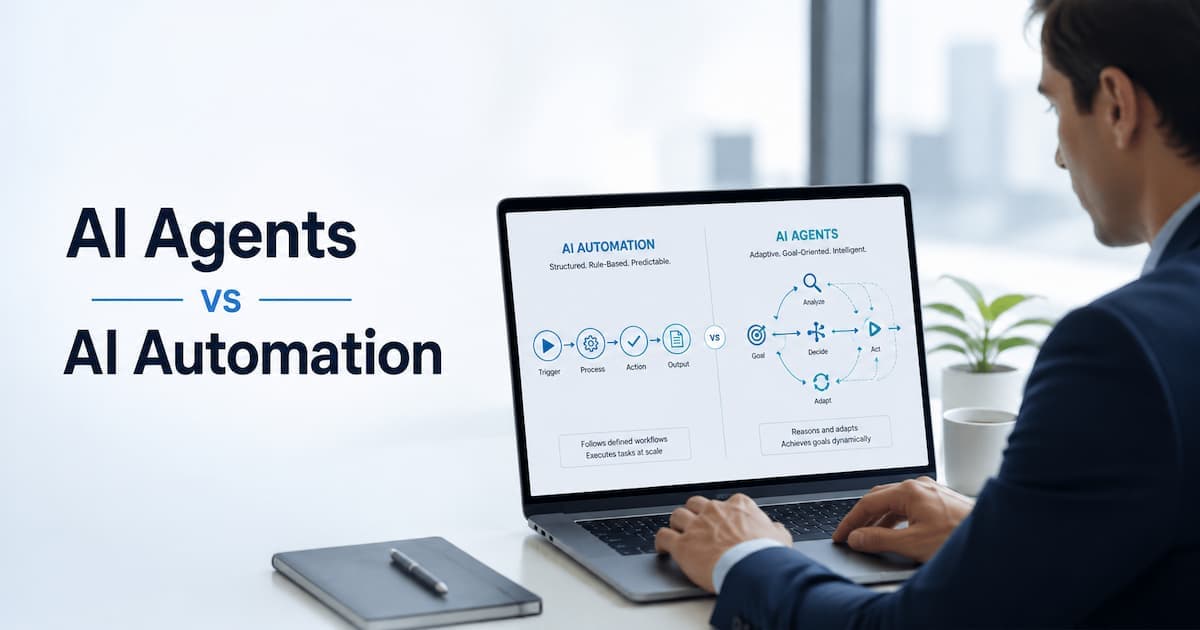
Traditional workflow automation follows fixed rules and executes defined actions when specific triggers occur. It handles only the scenarios it was programmed for and fails when conditions deviate from the expected pattern. AI agents follow goals rather than rules: they receive an objective, determine the path to achieve it, use tools and data to execute that path, and adapt when conditions change. AI agents handle the context-dependent, variable tasks that require reasoning rather than rule-following, making them suitable for a much broader range of real business workflows.
What is the right sequence for implementing AI agents and automation in a growing B2B business?
The right implementation sequence starts with data infrastructure: ensuring CRM data is clean, systems are connected, and operational data is accessible before any AI capability is deployed on top of it. Then automate one defined, high-volume workflow at a time and validate its performance before moving to the next. Layer AI agents onto automated foundations to handle the variable tasks surrounding defined workflows. Build governance infrastructure alongside every capability deployment. Measure business outcome metrics rather than activity volume to evaluate whether the investment is producing genuine value.
How does Mark Mates help businesses implement the new AI agent and automation business stack?
Mark Mates works with B2B growth leaders to design and implement the new business stack architecture that matches their specific operational context and growth objectives. Our approach covers data infrastructure assessment and improvement, workflow mapping and automation prioritization, AI agent deployment strategy for the highest-value use cases, governance framework design for sustainable operation, and the marketing and brand strategy that communicates the operational transformation to clients and partners in ways that build competitive advantage. For businesses ready to move from fragmented automation experiments to a coherent, compounding operational stack, Markmates provides the strategic foundation and implementation support that makes the transition genuinely effective.
Conclusion: The Stack Is the Strategy
The businesses that will define their markets over the next decade are not necessarily the ones with the best product, the largest team, or the biggest marketing budget.
They are the ones that figured out, earlier than their competitors, how to configure AI agents, intelligent automation, and human decision-making into an operational architecture that scales output without scaling cost, improves with every cycle, and frees the human capacity that drives genuine competitive differentiation.
The new business stack is not a technology investment. It is a strategic architecture decision that determines whether your business grows efficiently or grows expensively, whether your best people spend their time on the work that matters most or on the work that machines could handle, and whether your operational infrastructure compounds its advantage over time or plateaus at the efficiency ceiling of manual processes.
At Mark Mates, we help the businesses that understand this build the stack that makes it real.
Want to see if we're a fit?
Book a free call. We'll look at where your projects or marketing are getting stuck and tell you honestly whether we can help. No pressure either way.
Book your free strategy call