

Your business just spent six figures on automation software. Twelve months later, your team is still doing the same manual work, just with more expensive tools running in the background.
This is the reality for most businesses in 2026. According to research by McKinsey, over 70% of digital transformation and automation initiatives fail to meet their original objectives. The tools were fine. The budgets were there. The problem was almost always strategy, execution, and the human factors that no software vendor puts in their sales deck.
At Mark Mates, we don’t just automate tasks, we design intelligent growth systems. We’ve worked with 50+ businesses across industries and seen the same five critical mistakes derail automation projects worth hundreds of thousands of dollars. In this blog, we break all five of them down, and show you exactly how to avoid them so your automation strategy actually delivers the ROI it promised.
What Is Automation in Modern Business?
Before we diagnose where automation fails, it is worth being precise about what we mean by automation, because not all automation is equal, and confusing the types is itself one of the root causes of failure.
Task Automation
Task automation handles single, repetitive actions, sending a confirmation email, moving a file, or updating a spreadsheet. It is the most common and least transformative form of automation. Most businesses stop here and wonder why nothing changed.
Process Automation
Business process automation connects multiple tasks into a coherent workflow, from lead capture through to CRM update, notification, and follow-up sequence. This is where real efficiency gains begin to appear at a meaningful scale.
Intelligent Automation
Intelligent automation combines process automation with AI-driven decision-making. Systems do not just execute steps, they evaluate conditions, handle exceptions, learn from outcomes, and adapt. This is the frontier where the biggest ROI lives in 2026, and where agentic AI workflows are rapidly replacing traditional rule-based systems.
Key Insight: Most businesses automate at the task level but expect process-level or intelligent-level results. Misaligned expectations at this stage are the starting point of most automation failures.
Why Most Automation Initiatives Fail
Let’s be direct:
Automation technology in 2026 is mature, capable, and widely accessible. The tools are not the problem. When automation projects fail, the cause almost always falls into one of three categories:
- Lack of coherent automation strategy before implementation begins.
- Poor execution: automating the wrong things, in the wrong order, without the right integration.
- No plan for scalability: solving for today’s problem without building infrastructure for tomorrow’s growth.
McKinsey Global Institute: 70%+ of large-scale automation and digital transformation projects fail to meet their stated goals, most due to strategic and organisational failures, not technical ones.
The following five reasons account for the vast majority of automation failures we see across the businesses Mark Mates works with. Understanding them is the first step to building something that actually scales.
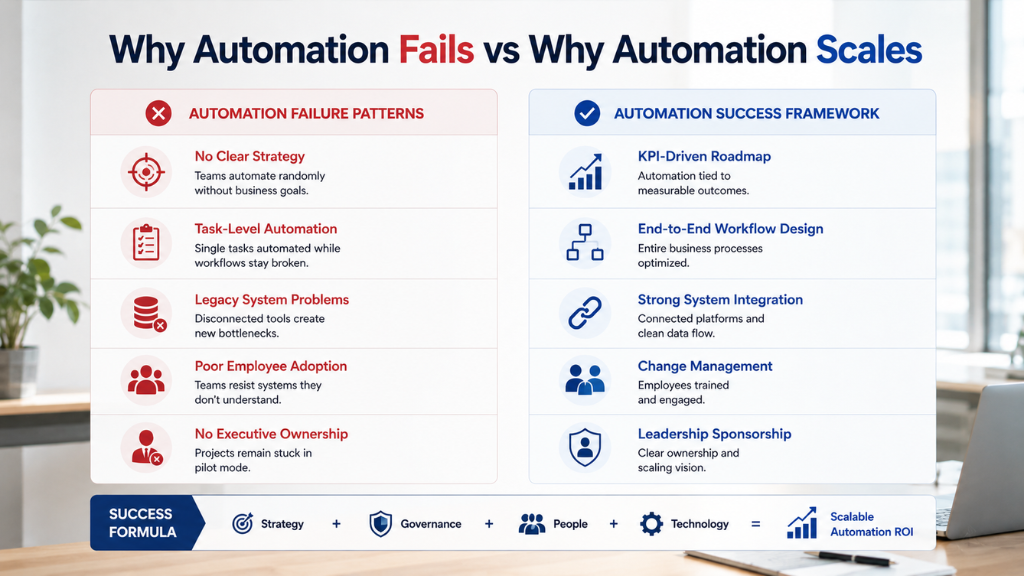
5 Major Reasons Automation Initiatives Fail
1. No Automation Strategy or Governance Model
The single most common cause of automation failure is launching before building a strategy. Businesses see a tool, buy a licence, and start automating whatever seems most annoying, with no roadmap, no defined KPIs, and no ownership structure to guide decisions.
Without an automation governance model, you quickly end up with dozens of disconnected automations built by different teams, running on different platforms, with no central visibility, no version control, and no way to measure whether any of it is actually working.
The Fix: Build a KPI-driven automation roadmap before you touch a single tool. Define what success looks like in measurable terms, cycle time reduction, error rate, cost per process, revenue impact. Assign ownership. Create a governance structure that controls how automations are built, tested, monitored, and retired.
→ Build your automation roadmap with Mark Mates
2. Automating Tasks Instead of End-to-End Processes
This is perhaps the most expensive mistake in business process automation, and it is extraordinarily common. A business automates the invoice approval step, but everything before and after it is still manual. The bottleneck shifts by one step, the overall process stays slow, and the team wonders why the automation made no difference.
Silo-based automation, where each department builds its own automations in isolation, creates new complexity without solving the underlying workflow problem. The customer experience, which cuts across every department, remains fragmented and inconsistent.
The Fix: Map the full customer journey and identify the complete end-to-end workflow before automating any single step. Use process mining tools to understand where time is genuinely being lost and where automation will have the highest systemic impact. Automate workflows, not tasks.
Key Insight: Automating a task in a broken process does not fix the process, it just makes the breakage faster and harder to see.
3. Poor IT Architecture Alignment and Legacy System Integration
Many automation projects stall because the tools chosen cannot actually talk to each other inside the existing IT environment. The CRM does not connect to the ERP. The RPA bot breaks every time the legacy system updates its interface. The low-code platform cannot access the data it needs because the IT architecture was never designed for automation at scale.
According to Gartner research, IT architecture misalignment is cited as a primary blocker in over 60% of failed automation deployments at enterprise level. The same pattern appears in mid-market businesses that did not involve IT leadership in the automation decision.
The Fix: Involve your IT architecture team from day one. Conduct a digital infrastructure compatibility audit before selecting any automation platform. Prioritise tools with robust API connectivity and a clear integration roadmap for your existing tech stack. For legacy system integration, plan migration or middleware solutions in parallel with automation design.
4. Ignoring Change Management and Employee Training
Automation does not just change processes, it changes how people work, what they are responsible for, and in some cases, whether their role exists in its current form. Businesses that roll out automation without a change management strategy face significant employee resistance, low adoption rates, and automations that get quietly worked around rather than used.
Research from Prosci’s Change Management Best Practices shows that projects with excellent change management are 6X more likely to meet their objectives than those with poor change management. Automation is fundamentally a people project that happens to use technology.
The Fix: Build a workforce transformation plan alongside your automation roadmap. Communicate early and honestly about what is changing and why. Invest in automation training programs that give employees the skills to work alongside new systems. Create internal champions, people who understand the technology and can support colleagues through the transition.
Key Insight: Employees who understand why automation is being deployed, and feel equipped to work with it, become its biggest advocates. Employees who feel threatened by it become its biggest blockers.
→ See how we manage automation change for clients
5. No Leadership Buy-In or Scaling Vision
Automation projects that begin as departmental experiments, driven by a motivated operations manager or IT lead, rarely scale into company-wide transformation. Without C-level ownership and a clear long-term vision, automation stays trapped in pilot phase, underfunded, and disconnected from the business strategy that would give it real impact.
No executive sponsor means no budget security, no cross-functional authority, and no clear mandate to drive adoption across departments. The automation works in one corner of the business and goes no further.
The Fix: Tie every automation initiative to a measurable business KPI that the C-suite already cares about, revenue growth, cost reduction, customer satisfaction score, or time-to-market. Present automation not as a technology project but as a business strategy. Secure executive sponsorship before scaling. Build a phased automation lifecycle management plan that shows leadership the path from pilot to enterprise-wide deployment with clear milestones.
Mark Mates Finding: Automation projects with defined C-level sponsorship and KPI alignment are 4X more likely to reach full-scale deployment within 18 months.
The Shift from Task Automation to Agentic AI Workflows
The automation landscape is changing faster in 2026 than at any previous point. Traditional RPA-style automation rule-based, brittle, and limited to structured data is giving way to something far more powerful: agentic AI workflows.
What Are Agentic AI Systems?
Agentic AI refers to autonomous AI agents that can plan, decide, and execute complex multi-step tasks without human intervention at each stage. Unlike traditional automation, which follows fixed rules, agentic systems can handle exceptions, reason through ambiguous situations, and coordinate with other agents to complete end-to-end workflows. According to analysis from MIT Technology Review, multi-agent AI systems represent the next major frontier in enterprise automation with adoption accelerating rapidly across financial services, logistics, and professional services.
Real-World Agentic AI Workflow Examples
Here is what intelligent automation looks like in practice when agentic systems are deployed:
- Lead generation → AI scoring → CRM routing → personalised outreach sequence → sales handoff — all executed autonomously with human review only at the handoff stage.
- New hire trigger → document collection → IT provisioning → onboarding task assignment → training scheduling → 30-day check-in workflow — zero manual coordination required.
- Support ticket → AI triage → knowledge base resolution attempt → escalation routing → agent briefing with full context — resolution time cut by 60–80%..
The New Bottleneck: Automation Governance and Risk Control
As automation scales, and especially as AI agents gain more decision-making authority, governance becomes the most critical success factor that most businesses have not yet built.
Without a robust automation governance model, scaled automation creates new categories of risk:
- Compliance violations when automated decisions do not meet regulatory requirements.
- Invisible errors that propagate through connected systems at machine speed before anyone notices.
- Shadow automation unauthorised workflows built by individual teams outside IT visibility.
- Audit failures when there is no documented trail of what automated systems decided and why.
At Mark Mates, we build governance frameworks alongside every automation strategy we deploy. Governance is not overhead, it is the infrastructure that makes automation scalability possible without unacceptable risk.
How to Build a Successful Automation Strategy in 2026
After working with 50+ businesses on automation strategy, Mark Mates has developed a proven five-stage framework for building automation that scales. Here is the roadmap:
Stage 1: Start with Process Mining: Use process mining tools to map current workflows, identify true bottlenecks, and quantify the cost of each inefficiency before automating anything.
Stage 2: Define Your Automation KPIs: Define 3–5 automation KPIs tied directly to business outcomes. Cost per process, cycle time, error rate, and customer satisfaction are the most impactful starting points.
Stage 3: Automate Full Workflows: Design automation at the workflow level, not the task level. Map the full end-to-end journey and automate the connective tissue between steps, not just the steps themselves.
Stage 4: Align IT and Business Teams: Conduct a tech stack integration audit. Ensure every automation tool is compatible with your existing IT architecture and has a clear data governance model.
Stage 5: Optimise Continuously: Build a continuous improvement automation cycle. Monitor KPIs, identify new bottlenecks created by automation, retrain AI systems on updated data, and expand scope systematically.
Mark Mates Clients: Businesses that follow this five-stage framework see an average 3.1X improvement in process efficiency within the first year of full deployment.
Start your automation strategy with Mark Mates
The Real Business Impact of Intelligent Automation
When automation is implemented strategically, with the right governance, people strategy, and end-to-end workflow design, the business impact is significant and measurable:
Cost Reduction at Scale
Well-designed process automation typically reduces operational costs by 25–50% for the workflows it covers, by eliminating manual handling, reducing error correction costs, and accelerating cycle times. At the enterprise level, this translates to millions in recovered operational capacity.
Faster, More Consistent Customer Experiences
End-to-end workflow automation removes the delays and inconsistencies introduced by manual handoffs between teams. Customers get faster responses, fewer errors, and a more consistent experience regardless of which team member handled their request.
Scalability Without Proportional Headcount Growth
The single most powerful benefit of mature automation is the ability to scale revenue without scaling costs at the same rate. Businesses with intelligent automation systems can handle 2–3X the volume with the same core team, making growth fundamentally more profitable.
Frequently Asked Questions (FAQs)
Why do most automation projects fail?
Most automation projects fail due to lack of strategy, poor governance, weak IT integration, and insufficient change management, not because of the technology itself. Businesses that automate without a clear roadmap and KPI framework almost always see disappointing results.
What is intelligent automation?
Intelligent automation combines traditional business process automation with AI-powered decision-making. Unlike rule-based RPA, intelligent automation can handle exceptions, process unstructured data, and adapt to changing conditions, making it far more scalable and resilient.
What is agentic AI and how does it affect automation?
Agentic AI refers to autonomous AI agents capable of planning and executing complex multi-step tasks independently. In automation, agentic systems replace rigid rule-based workflows with intelligent, adaptive processes that can coordinate across systems and handle edge cases without human intervention at every step.
How do you scale automation successfully in a business?
Successful automation scaling requires: a KPI-driven roadmap, end-to-end workflow design (not just task automation), IT architecture alignment, a change management programme for employees, and a governance framework that maintains visibility and compliance as the system grows.
What is an automation governance model?
An automation governance model is the framework that controls how automations are designed, tested, monitored, and retired within a business. It includes ownership structures, compliance controls, performance monitoring, and risk management protocols, essential for safe scaling.
How long does it take to see ROI from automation?
Businesses with a clear strategy and proper implementation typically see measurable ROI within 6–12 months of full deployment. Mark Mates clients following a structured automation roadmap see an average 3.1X improvement in process efficiency within the first year.
What is the difference between task automation and process automation?
Task automation handles a single repetitive action in isolation, sending an email, updating a record. Process automation connects multiple tasks into a complete end-to-end workflow. Process automation delivers far greater business impact because it eliminates the manual handoffs between steps that create the most delay and error.
Conclusion: Automation Is a Strategy, Not a Tool
In 2026, the businesses winning through automation are not the ones with the most bots or the biggest software budget. They are the ones that approached automation as a strategic discipline, with a clear roadmap, meaningful KPIs, end-to-end workflow thinking, strong IT alignment, and a genuine commitment to bringing their people along for the journey.
The five mistakes outlined in this blog are entirely avoidable. But avoiding them requires a fundamentally different mindset: automation as a long-term business transformation, not a quick operational fix. The rise of agentic AI and intelligent automation systems means the potential upside has never been greater, and the cost of getting it wrong has never been higher.
At Mark Mates, we don’t just help businesses automate, we help them build intelligent growth systems that scale. From automation strategy and process design to AI workflow implementation and governance frameworks, we partner with businesses that are serious about building something that lasts. Explore our client results and see what strategic automation actually delivers.
Ready to build an automation strategy that actually scales?
Mark Mates designs intelligent automation systems rooted in strategy, data, and measurable business outcomes.
Book Your Free Automation Audit and Discover Where You’re Losing Revenue